




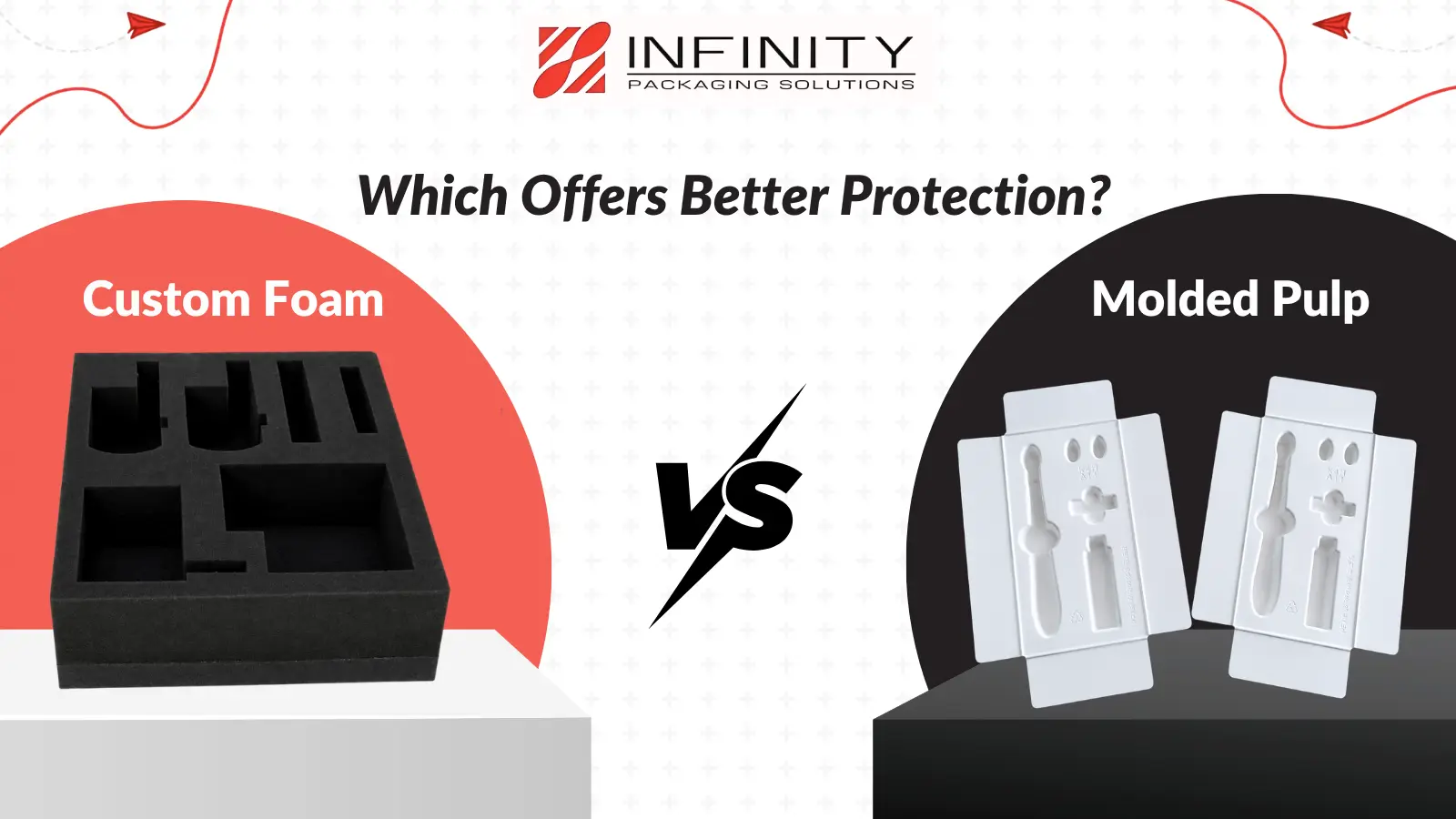
Protective packaging plays a major role in reducing product damage, improving customer satisfaction, and protecting profit margins across modern supply chains. For manufacturers, retailers and eCommerce brands, the right packaging material can directly impact shipping performance, sustainability goals, product presentation and overall operating costs.
Two of the most commonly compared protective packaging materials are custom foam packaging and molded pulp packaging. Both are used to protect products during transportation, storage, and retail handling, but they serve different business needs. Custom foam packaging is known for its precision fit, shock absorption and premium protection, while molded pulp packaging is valued for recyclability, biodegradability and eco-conscious brand positioning.
This guide compares custom foam vs molded pulp packaging across protection, cost, sustainability, shipping performance, product fit and branding so B2B brands can choose the right packaging solution for their products and supply chain requirements.
Custom foam packaging is better for fragile, high-value and precision products because it offers superior shock absorption, vibration resistance and custom-fit protection. Molded pulp packaging is better for brands prioritizing sustainability, recyclability, and lower production costs. The best choice depends on product fragility, shipping conditions, budget and environmental goals.
What Is Custom Foam Packaging?
Custom foam packaging is a protective packaging solution designed using engineered foam materials that cushion products during shipping, warehousing, and retail handling. Foam inserts are cut, shaped, or fabricated to match the exact dimensions of a product, helping reduce movement inside the box and improving impact resistance during transit.
Because custom foam inserts can be made with precise cavities, layered structures, and different foam densities, they are often used for products that require high protection, clean presentation or special handling.
Common Custom Foam Packaging Materials
- EVA foam
- Polyurethane foam
- Polyethylene foam
- Anti-static foam
- Cross-linked foam
- Reusable foam inserts
Industries That Use Custom Foam Packaging
- Consumer electronics packaging
- Medical device packaging
- Automotive component packaging
- Aerospace packaging
- Luxury retail packaging
- Industrial equipment packaging
- Precision instrument packaging
What Is Molded Pulp Packaging?
Molded pulp packaging, also called molded fiber packaging, is made from recycled paper fibers, cardboard, or other biodegradable materials. It is commonly used as an eco-friendly alternative to plastic packaging and some types of foam protective packaging.
Molded pulp is shaped into trays, inserts, carriers, and protective forms that hold products in place. It is widely used by brands that want recyclable, biodegradable and compostable protective packaging with a natural, sustainable appearance.
Common Applications of Molded Pulp Packaging
- Food packaging
- Electronics trays
- Consumer goods packaging
- Beverage carriers
- Cosmetic packaging
- Retail product inserts
- Industrial protective inserts
Custom Foam vs Molded Pulp Packaging: Quick Comparison
| Factor | Custom Foam Packaging | Molded Pulp Packaging |
| Best For | Fragile, high-value, precision products | Sustainable, lightweight, retail products |
| Protection Level | Excellent impact and vibration protection | Moderate to strong protection |
| Product Fit | Highly precise custom-fit inserts | Molded fit with less precision |
| Shock Absorption | Superior cushioning performance | Good cushioning for many products |
| Moisture Resistance | Strong | Moderate |
| Sustainability | Depends on foam type and reuse options | Strong; recyclable and biodegradable |
| Cost | Higher due to engineering and fabrication | Often lower for high-volume production |
| Branding Feel | Premium and luxury | Natural and eco-conscious |
| Best Industries | Electronics, medical, aerospace, automotive | Food, cosmetics, retail, consumer goods |
Which Packaging Material Offers Better Protection?
When maximum product protection is the main priority, custom foam packaging generally performs better than molded pulp packaging. Foam offers stronger shock absorption, vibration resistance, and precision cushioning, making it ideal for fragile items, high-value products, and products that cannot shift during transit.
Custom foam inserts are especially useful when the product has delicate edges, sensitive components, polished surfaces or electronic parts that need anti-static protection. The ability to engineer foam density, thickness and cavity shape gives brands more control over packaging performance.
Custom Foam Packaging Provides:
- Superior shock absorption packaging performance
- Better vibration control during transportation
- Precision-fit cushioning for fragile products
- Strong impact resistance and drop protection
- Anti-static protection for electronics
- Premium product presentation and unboxing experience
Best Products for Custom Foam Packaging
- Electronics and circuit boards
- Medical equipment and diagnostic devices
- Glass products and delicate components
- Industrial tools and instruments
- Aerospace components
- Precision instruments and luxury products
When Does Molded Pulp Packaging Perform Better?
Molded pulp packaging performs better when sustainability, recyclability and cost efficiency are the top priorities. It is a strong option for products that need moderate protection but do not require the same level of precision cushioning as custom foam inserts.
Modern molded fiber packaging can provide reliable protection for many lightweight products while helping brands reduce plastic usage and support ESG packaging goals. It also creates a natural and eco-conscious brand image, which is useful for retail products, food packaging, cosmetics, and consumer goods.
Molded Pulp Packaging Is Best For:
- Consumer goods packaging
- Food and beverage packaging
- Cosmetic packaging
- Retail product trays
- Lightweight electronics accessories
- Household products
- Sustainable product brands
Sustainability Comparison: Foam Packaging vs Molded Pulp Packaging
Sustainability is now a major factor in packaging procurement decisions. Brands are under pressure to reduce plastic waste, improve recyclability, and choose packaging materials that support sustainable supply chain goals.
Molded Pulp Sustainability Advantages
- Made from recycled paper fibers
- Biodegradable and compostable in many cases
- Highly recyclable
- Supports plastic-free packaging goals
- Helps improve eco-conscious brand perception
- Aligns with sustainable packaging and ESG initiatives
Because of these benefits, molded pulp packaging is often the stronger choice for brands that want sustainable protective packaging or eco-friendly packaging alternatives.
Is Custom Foam Packaging Sustainable?
Traditional foam packaging can face sustainability challenges because some foam materials are difficult to recycle. However, foam packaging is also evolving. Brands can now explore reusable foam inserts, recyclable foam options, reduced-density foam materials, and hybrid packaging systems that reduce material usage while maintaining strong protection.
Even with these improvements, molded pulp packaging usually remains the stronger sustainability option overall. Custom foam packaging remains the stronger protection option for fragile, expensive, or highly sensitive products.
Cost Comparison: Which Packaging Is More Cost-Effective?
For high-volume production, molded pulp packaging is often more cost-effective because it uses recycled materials and can be manufactured efficiently at scale. This makes it a practical choice for consumer goods, food packaging, cosmetics, and retail products.
Custom foam packaging usually costs more because it requires product-specific engineering, material selection, cutting, tooling, and insert fabrication. However, the higher upfront cost can be justified when the product is expensive, fragile or vulnerable to shipping damage.
Why Molded Pulp Often Costs Less
- Lower raw material costs
- Use of recycled fibers
- Efficient high-volume production
- Simpler material engineering
Why Custom Foam Packaging Costs More
- Precision engineering and design
- CNC cutting or custom fabrication
- Specialized foam material selection
- Product-specific insert development
- Higher protection performance
Shipping Performance Comparison
Shipping performance directly affects product damage rates, return costs, customer satisfaction, and operational efficiency. The right protective packaging should match the product weight, fragility, shipping distance, handling environment, and warehouse conditions.
Foam Packaging Advantages for Shipping
- Excellent vibration protection
- Strong drop resistance
- Lightweight cushioning
- Better product stability inside the box
- Reduced risk of damage for fragile and high-value products
Molded Pulp Advantages for Shipping
- Good stackability
- Sustainable packaging compliance
- Reduced environmental waste
- Retail-friendly structure
- Suitable for lightweight and moderate-risk products
Retail and Branding Considerations
Packaging does more than protect a product. It also influences customer perception, retail presentation, and the overall unboxing experience. This is especially important for premium products, consumer electronics, cosmetics and direct-to-consumer brands.
Custom Foam Packaging Creates:
- Premium product presentation
- Luxury packaging aesthetics
- Organized product layout
- High-end unboxing experience
- Strong perceived product value
Molded Pulp Packaging Creates:
- Eco-conscious brand perception
- Sustainable packaging identity
- Natural minimalist aesthetics
- Plastic-free packaging appeal
- Strong alignment with environmentally aware customers
Many brands now use both materials strategically. For example, a premium electronics brand may use custom foam inserts for sensitive devices, while a consumer goods brand may choose molded pulp packaging to support sustainability messaging.
Decision Matrix: Which Packaging Should Your Business Choose?
| Choose Custom Foam Packaging If | Choose Molded Pulp Packaging If |
| Maximum product protection is critical | Sustainability is a top priority |
| You ship fragile, expensive, or precision products | You need eco-friendly packaging alternatives |
| Your product needs shock absorption and vibration control | You want lower production costs at volume |
| You need custom foam inserts with exact product fit | Your products need moderate protection |
| You sell premium electronics, medical devices, or industrial components | You sell food, cosmetics, consumer goods, or retail-ready products |
Can Brands Use Foam and Molded Pulp Together?
Yes. Many businesses now use hybrid protective packaging systems that combine molded pulp structures with custom foam inserts. This approach can help brands balance protection, sustainability, cost, and presentation.
For example, molded pulp can be used as the outer support structure, while custom foam can be used around delicate components that need extra cushioning. Hybrid packaging is especially useful when a product requires both eco-conscious packaging and strong impact protection.
How to Choose the Right Protective Packaging Solution
The best packaging solution depends on the product, supply chain, customer expectations, and business priorities. Before choosing between custom foam and molded pulp packaging, brands should evaluate:
- Product fragility and value
- Shipping distance and handling risk
- Moisture exposure
- Sustainability requirements
- Packaging budget
- Retail presentation needs
- Brand positioning
- Return and damage costs
If product damage would be expensive or harmful to the customer experience, custom foam packaging may be the smarter investment. If sustainability and high-volume cost control are more important, molded pulp packaging may be the better choice.
Need Help Choosing the Right Protective Packaging?
Choosing between custom foam and molded pulp depends on your product value, fragility, shipping route, sustainability goals, and budget. InfinityPak can help you design a protective packaging solution that reduces damage, improves presentation, and supports your supply chain requirements.
If your product requires high shock absorption, precision cushioning, or premium presentation, explore our custom foam packaging solutions designed for fragile and high-value products.
Final Thoughts:
Both custom foam packaging and molded pulp packaging offer valuable protective packaging solutions for modern B2B brands. Custom foam provides superior cushioning, precision fit, and impact protection, making it ideal for fragile and high-value products. Molded pulp packaging offers strong sustainability advantages while supporting eco-conscious retail strategies and cost-efficient high-volume packaging.
The right choice depends on product safety, customer experience, sustainability goals, cost efficiency, and brand positioning. For brands looking to reduce shipping damage and improve packaging performance, working with an experienced custom packaging manufacturer can help identify the most effective protective packaging solution for their products and supply chain requirements.