




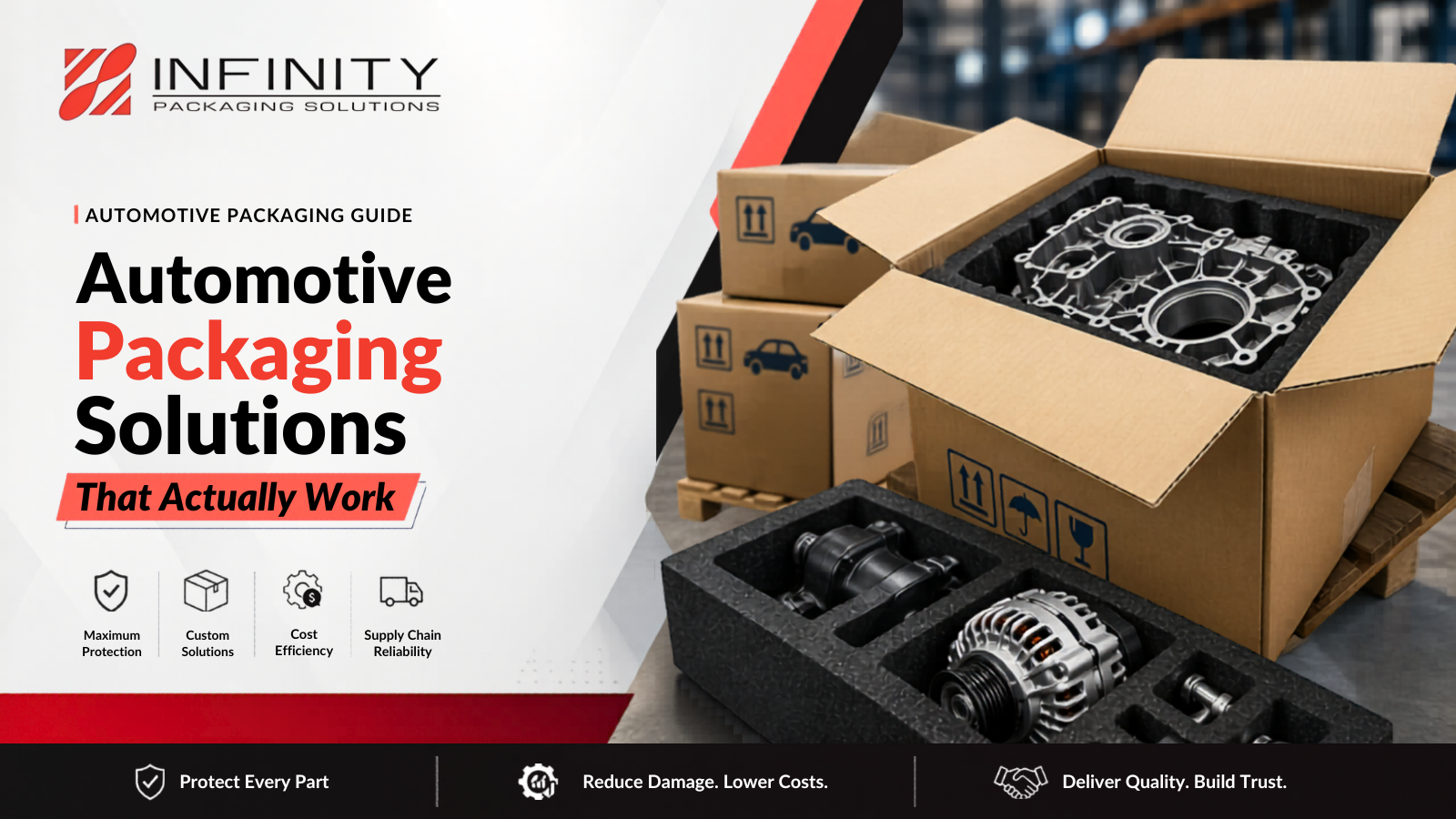
The automotive industry does not forgive mistakes. A small scratch on a component. A slight dent during transit. Even minor damage can lead to serious losses, delays, and unhappy clients.
That is why choosing the right automotive packaging solutions is not just a support function, it is a critical business decision. From heavy engine parts to delicate electronic modules, every component requires packaging that can handle impact, vibration and environmental exposure. Not overdone. Not underdone. Just right.
So, what actually works? Which packaging solutions for automotive parts deliver real value, not just cost savings on paper? Let’s break it down in a simple, practical and expert-backed way.
Why Packaging Matters in the Automotive Industry
Automotive products are not like regular consumer goods. They are:
- Heavy and irregular in shape
- Sensitive to impact, moisture, and vibration
- High-value components with strict quality standards
A weak packaging strategy can result in:
- Increased product damage
- Higher return rates
- Supply chain delays
- Loss of brand trust
Industry Insight:
Studies show that poor packaging contributes to nearly sixty percent of transit-related damages in industrial supply chains. That is a serious number.
What Makes a Good Automotive Packaging Solution?
Before choosing materials or designs, it helps to understand the fundamentals.
A strong Packaging Solutions strategy should:
- Protect against shock and vibration
- Handle weight without collapsing
- Resist environmental factors like humidity
- Optimise storage and transport space
- Support easy handling and logistics
Sounds simple. But execution is where most brands struggle.
Best Packaging Solutions for Automotive Parts
Different automotive components need different approaches. There is no one-size-fits-all solution.
Let’s look at what actually works.
1. Custom Corrugated Boxes for Automotive Packaging
These are widely used. And for good reason.
Custom corrugated boxes offer:
- High strength-to-weight ratio
- Flexibility in design and size
- Cost-effective scalability
For automotive parts, especially mid-weight components, they provide excellent outer protection.
Now, when you move to Custom corrugated Packaging, things get more refined. You can design boxes that:
- Fit exact product dimensions
- Reduce empty space
- Minimise movement during transit
This directly reduces damage risk.
2. Custom Foam Inserts
Outer packaging is not enough. Internal protection matters just as much.
That is where custom foam inserts come in.
They help:
- Cushion delicate components
- Absorb shock during transport
- Prevent internal movement
Think about electronic control units or precision tools. Without foam inserts, even a strong box cannot prevent internal damage.
3. Heavy-Duty Corrugated Packaging for Automotive Parts
Now, this is where strategy becomes specific.
Custom corrugated boxes for Automotive Product are designed keeping industry needs in mind. These boxes:
- Support heavy loads
- Include reinforced layers
- Allow integration with inserts and partitions
They are not generic boxes. They are engineered solutions.
4. Returnable and Reusable Packaging
Many automotive companies now prefer reusable packaging.
Why?
- Reduces long-term costs
- Supports sustainability goals
- Improves supply chain efficiency
Common options include:
- Plastic crates
- Foldable containers
- Pallet boxes
5. Anti-Static and Moisture-Resistant Packaging
Modern vehicles rely heavily on electronics.
These components require:
- Anti-static protection
- Moisture control
- Temperature resistance
Special coatings and materials are used to protect such sensitive parts.
Real Impact: Data That Matters
The table below compares different automotive packaging solutions based on cost, durability and protection level:
| Packaging Type | Damage Risk | Cost Efficiency | Reusability | Protection Level |
| Standard Boxes | High | High | Low | Low |
| Custom Corrugated Packaging | Medium | High | Medium | High |
| Foam Insert Packaging | Low | Medium | Medium | Very High |
| Reusable Industrial Packaging | Very Low | Medium | High | High |
Insight: Combining Custom corrugated boxes with custom foam inserts delivers the best balance of cost and protection.
Key Features to Focus On
Not all packaging improvements are useful. Focus on what truly adds value.
1. Structural Strength
Packaging must handle weight and stacking pressure.
2. Precision Fit
Loose packaging increases movement and damage risk.
3. Layered Protection
Outer box + inner cushioning works best.
4. Ease of Handling
Design should support easy loading and unloading.
5. Sustainability
Use recyclable and reusable materials wherever possible.
How Packaging Affects Supply Chain Efficiency
Packaging is not just about protection. It directly impacts logistics.
Better Packaging Solutions can:
- Reduce shipping costs
- Improve warehouse space utilisation
- Speed up loading and unloading
- Lower return rates
A well-designed box can reduce empty space. That means more products per shipment. Simple, but powerful.
Cost vs Value: A Practical View
Many companies focus only on packaging cost. That is a mistake.
Let’s simplify:
| Factor | Basic Packaging | Advanced Packaging Solutions |
| Initial Cost | Low | Medium |
| Damage Risk | High | Low |
| Customer Trust | Low | High |
| Long-term Savings | Low | High |
Conclusion: Investing in better packaging reduces hidden costs over time.
Expert Insight: What Industry Leaders Are Doing
Top automotive brands are not cutting corners anymore.
They focus on:
- Custom-engineered packaging
- Integration of custom foam inserts
- Use of Custom corrugated Packaging for scalable operations
They treat packaging as part of the product, not an afterthought.
Common Mistakes to Avoid
Even experienced manufacturers make these mistakes:
- Using standard boxes for all products
- Ignoring internal cushioning
- Overpacking (increasing cost unnecessarily)
- Not testing packaging under real conditions
Avoid these, and half the problem is already solved.
Practical Steps to Choose the Right Packaging
Let’s keep it simple and actionable.
Step 1: Understand Your Product
- Weight
- Fragility
- Shape
Step 2: Identify Risks
- Transit conditions
- Handling frequency
- Environmental exposure
Step 3: Choose the Right Materials
- Corrugated boards
- Foam inserts
- Protective coatings
Step 4: Prototype and Test
Always test before full-scale implementation.
Step 5: Work with Experts
Partner with experienced providers who understand automotive needs.
Final Thoughts
In the automotive industry, packaging is not optional. It is strategic.
The right Packaging Solutions protect products, reduce costs, and improve customer trust. Simple changes—like using Custom corrugated boxes for Automotive Product with custom foam inserts—can deliver measurable results.
And in a market where precision matters, those small improvements make a big difference.
FAQs
1. What are the best automotive packaging solutions?
The best approach combines Custom corrugated boxes with custom foam inserts for maximum protection and cost efficiency.
2. Why are custom foam inserts important?
They prevent internal movement and absorb shock, reducing damage during transit.
3. Are Custom corrugated boxes suitable for heavy automotive parts?
Yes. When designed properly, they provide excellent strength and durability.
4. What is Custom Corrugated Packaging?
It refers to packaging designed specifically for a product’s size, weight, and protection needs.
5. How can companies reduce packaging costs?
By optimising design, reducing empty space, and using reusable packaging solutions.