




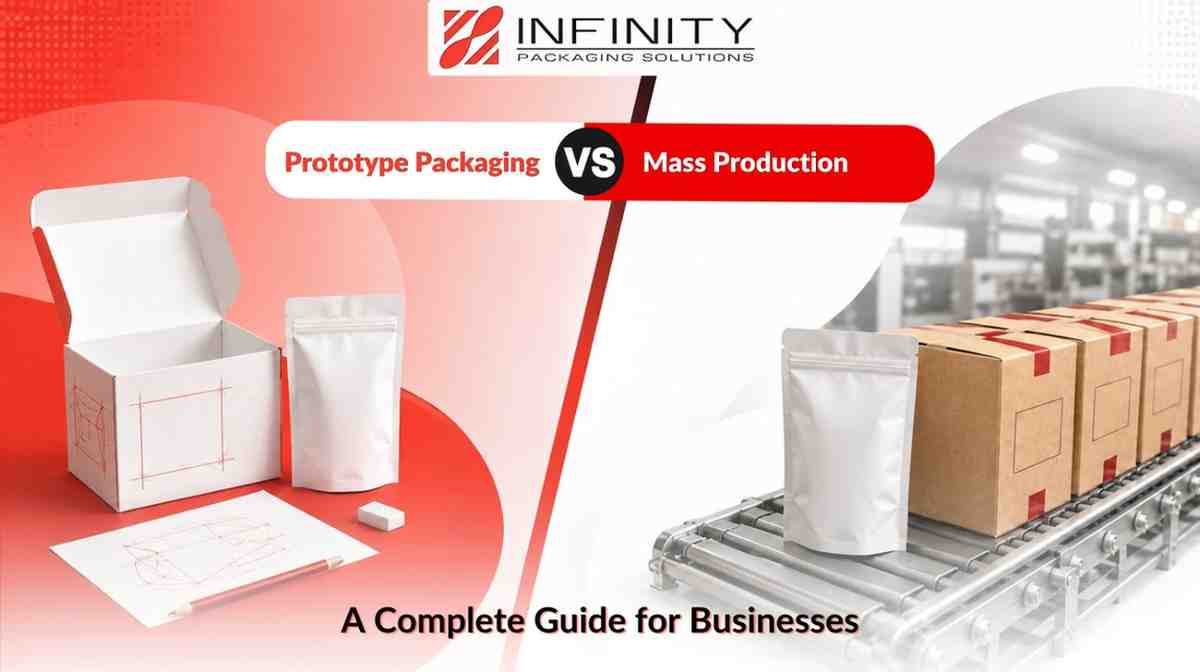
Launching a new product is exciting, but it’s also one of the riskiest stages for any business. Months of product development, branding, manufacturing and marketing can be affected by one overlooked decision — packaging.
Many businesses assume that once the artwork is approved, they can move directly into manufacturing thousands of boxes. Unfortunately, that’s where costly mistakes often begin. A product may not fit properly, printed colors may differ from brand guidelines, foam inserts may not protect delicate components, or the packaging may fail during shipping.
These problems don’t happen because of poor manufacturing. They happen because the packaging was never validated before production. This is where understanding Prototype Packaging vs Mass Production becomes essential.
A packaging prototype allows businesses to test, evaluate and improve packaging before committing to large production volumes. Mass production, on the other hand, focuses on manufacturing consistency and efficiency after every detail has been approved.
Whether you’re launching a premium retail product, shipping industrial equipment or developing custom packaging for a new product line, understanding these two stages can save your business time, money and unnecessary operational challenges.
Why Understanding Prototype Packaging vs Mass Production Can Save Your Business Thousands
One of the biggest misconceptions in the packaging industry is that prototype packaging is an unnecessary expense. In reality, it is often one of the smartest investments a business can make.
Imagine ordering 30,000 custom rigid boxes without first seeing a physical sample. Once production is complete, your team discovers that the product fits too tightly, the magnetic closure doesn’t align correctly, and the printed colors appear different from your approved artwork.
Correcting these issues after production could mean reprinting thousands of boxes, delaying product launches and increasing logistics costs.
A packaging prototype helps identify these issues while changes are still affordable.
Businesses that invest in prototype packaging generally experience:
- Fewer production delays
- Lower redesign costs
- Better product protection
- Improved customer experience
- Greater confidence before large-scale manufacturing
Rather than viewing a prototype as an additional cost, successful manufacturers view it as a way to reduce long-term business risk.
What Is Prototype Packaging and Why Do Successful Businesses Never Skip This Step?
Prototype packaging is the first physical version of your packaging design. Unlike a digital mock-up, it allows businesses to evaluate how the packaging performs in real-world conditions before committing to full production.
A prototype isn’t simply about checking appearance. It validates the complete packaging system, including dimensions, structural strength, printing quality, product fit, assembly, and shipping performance.
For example, a consumer electronics company may use a prototype to ensure a foam insert securely holds the product during transportation. A luxury brand may evaluate the unboxing experience and print quality before approving thousands of premium rigid boxes. An industrial manufacturer may test whether heavy components remain stable throughout long-distance shipping.
By identifying problems early, businesses can refine the design before production tooling and large material purchases begin.
What Happens During the Prototype Packaging Process?
A typical prototype packaging process includes:
- Reviewing product dimensions and packaging requirements.
- Selecting suitable packaging materials.
- Creating a structural packaging sample.
- Testing product fit and protective performance.
- Evaluating printing quality and branding.
- Making improvements before production approval.
Although the process adds a small amount of time to the project, it often prevents much larger production delays later.
What Is Mass Production Packaging and When Is Your Business Ready for It?
Once the packaging design has been tested, approved, and finalized, the project moves into mass production packaging.
This stage focuses on manufacturing efficiency rather than experimentation. Printing plates, cutting dies, production equipment, and quality control processes are optimized to produce thousands—or even millions—of identical packages.
Mass production works best when:
- Product dimensions have been approved.
- Structural packaging has been tested.
- Packaging materials have been finalized.
- Artwork and colors have been verified.
- Shipping performance has been validated.
Skipping these approvals before production can significantly increase costs if corrections become necessary later.
Prototype Packaging vs Mass Production: Side-by-Side Comparison
| Feature | Prototype Packaging | Mass Production |
| Primary Purpose | Test and validate the design | Manufacture at commercial scale |
| Quantity | Small batches | High-volume production |
| Design Changes | Easy and affordable | Expensive after production begins |
| Cost Per Unit | Higher | Lower due to volume |
| Product Testing | Yes | Already completed |
| Best For | New products and redesigns | Approved packaging designs |
The comparison highlights an important point: prototype packaging and mass production are not competing options, they are two stages of the same successful packaging development process.
Which Is Better for Your Business?
The right choice depends on your project.
If you’re launching a new product, changing packaging materials, entering a new market, or creating premium packaging, prototype packaging is almost always the better option. It provides an opportunity to validate every aspect of the packaging before investing in large production runs.
If you’re reordering an existing packaging design that has already been tested successfully, moving directly into mass production is generally the most efficient approach.
Rather than asking, “Which option is better?”, businesses should ask:
“Has my packaging been validated enough to justify large-scale production?”
That simple question often leads to smarter decisions.
Why Businesses Lose Money When They Skip Prototype Packaging
Most packaging problems are preventable.
When businesses move directly into production, they often discover issues only after the packaging has already been manufactured.
Common problems include:
- Incorrect product fit
- Weak structural design
- Print color inconsistencies
- Poor customer unboxing experience
- Shipping damage
- Retail compliance issues
The financial impact extends far beyond the packaging itself. Product replacements, warranty claims, emergency shipments, and delayed product launches all increase operational costs.
Prototype packaging reduces these risks by allowing businesses to test and improve the packaging before committing to production.
Prototype Packaging Cost vs Production Cost: Which Delivers Better ROI?
Many procurement teams focus only on packaging price.
Experienced manufacturers evaluate Total Cost of Ownership (TCO).
| Cost Factor | Prototype Packaging | Mass Production |
| Initial Investment | Moderate | Higher overall investment |
| Risk | Low | High if untested |
| Design Revisions | Affordable | Expensive |
| Product Testing | Included | Completed beforehand |
| Long-Term ROI | High | Depends on prototype validation |
A well-tested prototype often saves significantly more money than it costs.
Real Business Examples
- A medical device manufacturer may prioritize prototype packaging because precision and product protection are essential.
- A luxury cosmetics brand may use prototypes to evaluate print quality, customer experience, and shelf presentation before approving premium rigid boxes.
- An industrial equipment supplier may test protective packaging to reduce vibration damage during international transportation.
- Although these industries are different, they all share one goal: minimizing risk before production begins.
Expert Recommendation Before Approving Production
From a packaging manufacturer’s perspective, prototype packaging should never be viewed as a delay, it should be viewed as quality assurance.
Businesses often focus on reducing packaging costs during procurement. However, the greater financial risk usually comes from approving production before validating structural design, product fit, printing quality, and transportation performance.
Investing in a prototype early helps reduce redesign costs, improve manufacturing efficiency, and create a smoother product launch.
Final Thoughts
Choosing between prototype packaging and mass production is not about deciding which stage is better. It’s about understanding where your product is in its packaging development journey.
Prototype packaging helps businesses validate ideas, reduce production risks, and improve product performance before manufacturing begins. Mass production then delivers consistency, efficiency, and scalability once every detail has been approved.
Businesses that invest time in validating their packaging often experience fewer production issues, lower long-term costs, and stronger customer satisfaction.
Whether you’re developing custom rigid boxes, litho laminated boxes, custom foam packaging, thermoformed packaging, molded pulp packaging, chipboard boxes or retail display packaging, the most successful projects begin with careful planning, not rushed production.
Treat packaging as a business investment rather than a manufacturing expense and it will continue delivering value long after your product reaches the customer.
Frequently Asked Questions
Is prototype packaging necessary for every product?
No. It is most valuable for new products, packaging redesigns, and projects involving new materials or structures.
How many prototype samples should a business order?
This depends on the project. Most businesses begin with one or more samples for internal review, product testing, and stakeholder approval.
Can prototype packaging reduce overall costs?
Yes. Finding design issues before production is significantly less expensive than correcting thousands of finished packages.
Can prototype packaging use production materials?
In many cases, yes. Using production materials provides a more accurate evaluation of strength, appearance, and functionality.