




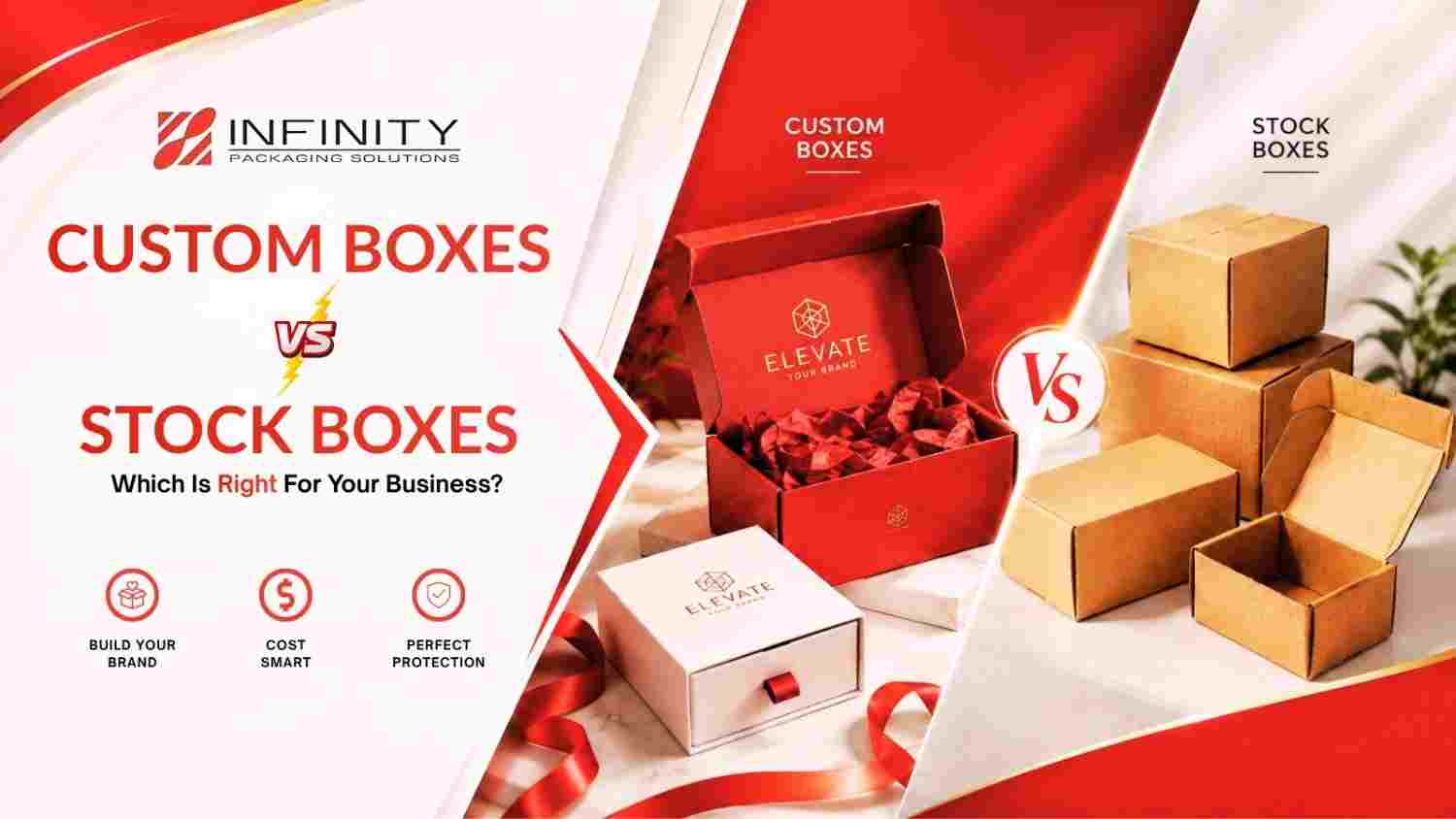
Choosing the right packaging can affect more than how a product looks when it reaches a customer. The right box can protect products during storage and shipping, improve the unboxing experience, support brand recognition, and help businesses manage packaging costs.
For most businesses, the decision often comes down to custom boxes vs. stock boxes. Stock boxes are pre-made in standard sizes and are generally easier to source, while custom boxes are designed around a specific product, brand, and packaging requirement.
So, which option is better?
Custom boxes are generally better for businesses that need precise product fit, stronger branding, premium presentation, custom inserts, or product-specific protection. Stock boxes are often better when speed, simplicity, standard sizing, and lower initial packaging costs are the priority.
The right choice depends on your product dimensions, shipping requirements, order volume, budget, branding goals, and customer experience.
In this guide, we compare custom packaging vs. stock packaging, explain the advantages and limitations of both options, and help you determine which type of packaging is right for your business.
Custom Boxes vs. Stock Boxes: Quick Comparison
If you need a quick comparison, the table below highlights the main differences between custom boxes and stock boxes.
| Feature | Custom Boxes | Stock Boxes |
| Size Options | Custom dimensions available | Standard sizes |
| Product Fit | Designed around the product | Depends on available sizes |
| Branding | Extensive customization | Limited |
| Printing | Custom printing available | Usually limited |
| Product Protection | Can be designed for specific requirements | Depends on box size and fit |
| Inserts | Custom inserts and compartments possible | Limited options |
| Design Flexibility | High | Low |
| Initial Cost | Generally higher | Generally lower |
| Lead Time | Usually longer | Usually faster |
| Minimum Order Quantity | May be higher | Often more flexible |
| Customer Experience | Highly customizable | Basic to moderate |
| Best For | Growing, established, premium and branded products | Standard products, startups and simple shipping needs |
Both packaging options can be effective. The better solution depends on what your business needs from its packaging.
What Are Custom Boxes?
Custom boxes are packaging boxes designed and manufactured according to a specific product, brand, or shipping requirement. Unlike standard packaging, custom boxes allow businesses to select dimensions, materials, structure, printing, finishes, inserts, and other packaging features.
Custom packaging is particularly useful when a product has unusual dimensions, requires additional protection, or needs a branded and premium presentation.
For example, a beauty brand may use custom printed boxes featuring its logo, brand colors, product information, and a specific finish. An electronics company may use custom packaging with inserts or compartments designed to keep the product secure during transportation.
Because the box can be designed around the product, custom packaging can also help reduce unnecessary empty space when the packaging structure is properly engineered.
Key Benefits of Custom Boxes
Custom boxes can provide several advantages:
- Product-specific dimensions
- Stronger brand visibility
- Custom printing and graphics
- Greater structural flexibility
- Custom inserts and compartments
- Improved product presentation
- Better control over product fit
- Packaging designed around shipping requirements
- More opportunities to create a branded unboxing experience
For businesses where packaging is an important part of the product experience, custom packaging boxes can offer significantly more flexibility than standard alternatives.
What Are Stock Boxes?
Stock boxes are pre-manufactured packaging boxes available in standard sizes, shapes, and materials. Because these boxes are produced in advance, businesses can generally purchase them without going through a custom design and manufacturing process.
Stock boxes can be a practical solution for products that fit common packaging dimensions and do not require extensive branding or specialized protection.
For example, businesses shipping books, clothing, accessories, documents or other standard-sized products may be able to use stock boxes without requiring a fully customized packaging solution.
Key Benefits of Stock Boxes
Stock boxes are often useful because they offer:
- Lower upfront packaging costs
- Standard sizes
- Faster availability
- Easy sourcing
- Simpler purchasing
- Flexible options for smaller packaging requirements
- Less design and development work
- Practical packaging for startups and small businesses
However, stock packaging boxes generally provide less flexibility when it comes to product fit, branding, structural design and custom inserts.
Custom Boxes vs. Stock Boxes: What Is the Difference?
The main difference between custom boxes and stock boxes is flexibility.
Stock boxes are manufactured around standard dimensions and general packaging requirements. Custom boxes, on the other hand, are designed around the specific needs of a product or brand.
The right choice should therefore be based on more than the initial price of the box.
Businesses should consider:
- Product dimensions
- Product weight
- Fragility
- Shipping conditions
- Branding requirements
- Packaging volume
- Storage requirements
- Customer experience
- Budget
- Production timeline
Let’s look at the most important differences in detail.
Product Fit: Which Packaging Fits Products Better?
Custom boxes generally provide a better product fit because their dimensions can be designed around the product.
With stock boxes, businesses have to select from available standard sizes. If the product does not fit properly, there may be unnecessary empty space around it. That space may require additional filler or cushioning to prevent movement during shipping.
With custom packaging, the box structure and dimensions can be developed around the product. Depending on the application, businesses can also add inserts, dividers, compartments, or other protective features.
This can be especially useful for:
- Fragile products
- Electronics
- Cosmetics
- Medical products
- Luxury products
- Industrial components
- Specially shaped products
Product Fit Comparison
| Factor | Custom Boxes | Stock Boxes |
| Product-Specific Dimensions | Excellent | Limited |
| Empty Space Control | High | Depends on available size |
| Custom Inserts | Available | Limited |
| Unique Product Shapes | Suitable | Less suitable |
| Product Presentation | Highly customizable | Basic |
If precise product fit is important, custom boxes are usually the stronger option.
Are Custom Boxes Better for Brand Recognition?
Custom packaging offers significantly more opportunities for branding than stock boxes.
Stock boxes generally have limited branding options. Businesses may need to use labels, stickers, printed tape, or other materials to add their brand identity.
With custom printed boxes, businesses can incorporate branding directly into the packaging.
Elements can include:
- Logo
- Brand colors
- Product information
- Graphics
- Patterns
- Taglines
- Marketing messages
- Instructions
- Website information
- Social media details
This allows the packaging itself to become a recognizable part of the brand.
For direct-to-consumer and e-commerce businesses, this can be particularly valuable because the package is often one of the first physical brand touchpoints customers experience after purchasing a product.
If brand recognition and branded packaging are important to your business, custom boxes provide much greater flexibility.
Are Custom Boxes More Expensive Than Stock Boxes?
Custom boxes generally have a higher initial cost than stock boxes, particularly when custom sizing, printing, tooling, materials, inserts, or specialized manufacturing are involved.
Stock boxes usually have a lower upfront cost because they are manufactured in standard sizes and do not require individual design and production for each customer.
However, businesses should not evaluate packaging only by the price per box.
The overall packaging cost can also include:
- Protective materials
- Filler material
- Shipping
- Storage
- Product damage
- Returns
- Replacement shipments
- Branding materials
- Customer complaints
For example, a stock box may have a lower purchase price but require additional filler because it is larger than the product. A custom box may cost more initially but provide a better fit and potentially reduce the need for additional packaging materials.
Cost Comparison
| Cost Factor | Custom Boxes | Stock Boxes |
| Initial Cost | Moderate to High | Low to Moderate |
| Design Cost | May apply | Usually none |
| Printing | Customizable | Limited |
| Additional Protection | Can be optimized | May be required |
| Branding | Integrated into packaging | May require labels or tape |
| Long-Term Value | Potentially high | Depends on application |
The cheapest box is not always the most cost-effective packaging solution.
Businesses should evaluate total packaging requirements rather than looking only at the initial box price.
Customer Experience: Which Boxes Create a Better Unboxing Experience?
Packaging can become an important part of the customer experience, particularly for brands selling directly to consumers.
Custom boxes provide more opportunities to create a branded and memorable unboxing experience.
Businesses can customize:
- Box colors
- Printed messages
- Product information
- Branded inserts
- Interior printing
- Premium finishes
- Product compartments
- Custom-fit structures
These details can make the packaging feel more intentional and aligned with the brand.
Stock boxes can still provide a positive customer experience when products are packed securely and presented neatly. However, they generally offer fewer opportunities for customization.
For brands where packaging and unboxing experience are part of the overall customer journey, custom boxes can provide a stronger advantage.
Product Protection: Are Custom Boxes Safer Than Stock Boxes?
There is no single answer because product protection depends on the box material, structure, dimensions, product weight, fragility, and shipping environment.
A properly selected stock box can provide reliable protection when the product fits correctly and appropriate cushioning is used.
However, standard packaging may not always provide the ideal fit.
Custom boxes can be designed around specific product dimensions and protection requirements. Depending on the application, businesses may incorporate inserts, dividers, compartments, or cushioning features.
Custom packaging can be particularly useful for:
- Fragile products
- High-value products
- Products with unusual dimensions
- Products requiring internal stabilization
- Items that are vulnerable to movement during shipping
Protection Comparison
| Protection Factor | Custom Boxes | Stock Boxes |
| Product-Specific Design | Excellent | Limited |
| Custom Inserts | Available | Limited |
| Product Stability | Excellent when properly designed | Depends on fit |
| Fragile Product Support | Highly customizable | Moderate to Good |
| Standard Products | Excellent | Excellent |
The best packaging is the one that provides adequate protection for the specific product and shipping environment.
Shipping and Storage Efficiency
Packaging dimensions can affect shipping, storage, and material usage.
A box that is significantly larger than the product can create unnecessary empty space and may require additional filler. Larger packaging can also occupy more storage space.
Custom packaging can be designed around product dimensions, which may help businesses create a more efficient packaging format.
However, the smallest possible box is not automatically the best solution. Packaging still needs sufficient protection for handling, transportation, stacking, and storage.
Stock boxes can also be highly efficient when a standard size already fits the product well.
Shipping Efficiency Comparison
| Factor | Custom Boxes | Stock Boxes |
| Size Optimization | Excellent | Limited |
| Product Fit | High | Moderate |
| Filler Requirement | Can potentially be reduced | May be required |
| Standard Products | Excellent | Excellent |
| Unique Products | Excellent | Limited |
Businesses should evaluate both packaging efficiency and product protection rather than optimizing only for box size.
Custom Packaging Design Flexibility
One of the biggest advantages of custom packaging is design flexibility.
Depending on the packaging application, businesses can customize:
- Box style
- Dimensions
- Materials
- Printing
- Colors
- Finishes
- Inserts
- Compartments
- Opening styles
- Structural features
This allows packaging to support both practical requirements and brand presentation.
Stock boxes are more limited because their dimensions and structure have already been established.
For businesses selling premium products or building a recognizable brand, custom box packaging can make packaging a stronger part of the overall product presentation.
Lead Time: Which Is Faster, Custom or Stock Boxes?
If packaging is needed quickly, stock boxes generally have the advantage.
Because stock boxes are already manufactured, businesses can often source standard packaging without waiting for a custom development and production process.
Custom boxes usually require additional planning. Depending on the project, the process may include:
- Understanding product requirements
- Selecting the packaging structure
- Choosing materials
- Developing artwork
- Reviewing samples
- Testing packaging
- Approving production
- Manufacturing the final boxes
For this reason, businesses should plan custom packaging well before a product launch or major packaging change.
Choose stock boxes when immediate availability is the priority. Choose custom boxes when product fit, branding and long-term packaging performance are more important.
Minimum Order Quantities for Custom and Stock Boxes
Minimum order quantities can influence the decision between custom and stock packaging.
Custom packaging may require larger production quantities depending on:
- Box structure
- Material
- Printing method
- Custom tooling
- Manufacturing requirements
Stock boxes may be available in smaller quantities because they are produced as standard packaging products.
For startups and businesses testing a new product, stock packaging can therefore be a practical starting point.
As order volume increases, custom packaging may become more attractive because businesses can better justify the design and production investment.
Custom Boxes vs. Stock Boxes for Small Businesses
Small businesses often need to balance packaging quality, branding, and budget.
Stock boxes can be a practical starting point for small businesses because they are generally simpler and require less initial investment.
However, custom boxes may be worth considering when:
- Packaging is part of the product experience
- Brand recognition is important
- Products have unique dimensions
- Products are premium or high-value
- Product protection is a major concern
- The business is developing a stronger brand identity
A business does not necessarily need to move to fully customized packaging immediately. Starting with stock packaging and transitioning to custom boxes as sales and packaging requirements grow can be a practical approach.
Custom Boxes vs. Stock Boxes for E-Commerce Brands
E-commerce businesses have specific packaging requirements because products are shipped directly to customers.
Packages can experience handling, movement, stacking, and transportation across multiple locations before reaching the final customer.
For this reason, e-commerce packaging needs to provide both product protection and presentation.
Custom boxes can help e-commerce brands create a recognizable delivery experience while allowing businesses to design packaging around their products.
Custom packaging can also help reduce unnecessary empty space when the box is designed appropriately for the product.
However, stock boxes remain a practical choice for e-commerce businesses that sell standard-sized products and prioritize low initial packaging costs.
Custom Packaging for Retail Products
Retail packaging often needs to perform multiple functions at once.
It may need to:
- Protect the product
- Communicate product information
- Represent the brand
- Support product presentation
- Provide relevant instructions
- Include regulatory information where applicable
Custom boxes give businesses greater control over these elements.
Custom retail packaging can incorporate the product name, features, branding, instructions, product information, graphics, and other relevant details.
Stock boxes can be more suitable when the packaging is primarily intended for transportation or when extensive branding is not required.
Sustainable Packaging: Are Custom or Stock Boxes Better?
Sustainability should not be determined simply by whether packaging is custom or stock.
Instead, businesses should consider how efficiently the packaging uses materials and how effectively it protects the product.
Important factors include:
- Amount of packaging material used
- Empty space
- Recyclability
- Product protection
- Packaging durability
- Packaging waste
- Use of additional filler materials
Custom boxes can be designed around product dimensions, which may help reduce unnecessary space and packaging material.
However, stock boxes can also be a responsible choice when an available standard size fits the product properly and does not require excessive filler.
The more sustainable packaging choice is the one that balances product protection, material efficiency, packaging waste, and business requirements.
When Should You Choose Custom Boxes?
Custom boxes are a strong option when packaging plays an important role in your product or brand strategy.
Choose Custom Boxes If Your Brand Is Growing
As a business grows, consistent packaging can become more important across products and sales channels.
Custom packaging allows brands to create a consistent visual identity and packaging experience.
Choose Custom Boxes for Premium Products
Premium products often benefit from packaging that reflects their perceived value.
Custom structures, printing, finishes, and inserts can create a more premium presentation.
Choose Custom Boxes for Unique Product Shapes
If a product does not fit standard packaging sizes, custom packaging can provide a better solution.
Choose Custom Boxes When Product Protection Is Critical
If product damage can lead to expensive returns, replacements, or customer dissatisfaction, packaging can be designed around the product’s protection requirements.
Choose Custom Boxes When Customer Experience Matters
For direct-to-consumer brands, packaging can become an important part of the overall customer experience.
Choose Custom Boxes for Stronger Brand Recognition
Custom printing allows businesses to integrate logos, colors, graphics, messaging, and other brand elements directly into the packaging.
When Should You Choose Stock Boxes?
Stock boxes can be the right choice when speed, simplicity, standard sizing, and lower initial packaging costs are the main priorities.
Consider stock packaging if:
- Your products fit standard box sizes
- You need packaging quickly
- Your packaging requirements are simple
- You are testing a new product
- Your current order volume is small
- Packaging is mainly used for shipping
- Extensive branding is not required
- You want to minimize initial packaging investment
Stock boxes can be particularly useful during the early stages of a business.
As sales increase and packaging requirements become more complex, transitioning to custom packaging may make more sense.
Common Mistakes When Choosing Packaging Boxes
Choosing packaging based only on price can create problems later.
Here are some common mistakes businesses should avoid when selecting custom or stock boxes.
Choosing the Cheapest Box
A lower purchase price does not always mean lower overall packaging costs.
Consider product protection, shipping, filler material, returns, replacement shipments, and customer experience.
Ignoring Product Dimensions
A box that is too large may create unnecessary empty space, while a box that is too small may compromise product protection.
Always evaluate the actual dimensions and requirements of the product.
Forgetting About Branding
If packaging is an important customer touchpoint, generic packaging may limit opportunities to build brand recognition.
Using Too Much Filler
Excessive filler can increase material usage and make packaging less efficient.
Selecting the appropriate box size and structure can help reduce unnecessary packaging materials.
Not Testing Packaging
Before moving to large-scale production, packaging should be evaluated under realistic handling and shipping conditions.
Testing can help identify potential packaging problems before they affect customers.
How to Choose Between Custom Boxes and Stock Boxes
The best way to choose the right packaging is to evaluate your actual business requirements.
Ask yourself:
- Does my product fit a standard box size?
- Is product protection a major concern?
- Do I need branded packaging?
- Is the customer unboxing experience important?
- How quickly do I need the boxes?
- What is my packaging budget?
- What is my expected order volume?
- Do I need custom inserts?
- Is my product premium or high-value?
- Will my packaging requirements change as the business grows?
Your answers can help determine whether custom packaging or stock packaging is the better fit.
Custom Boxes vs. Stock Boxes: Decision Guide
| If Your Priority Is… | Recommended Option |
| Lowest initial packaging cost | Stock Boxes |
| Fast packaging availability | Stock Boxes |
| Standard product dimensions | Stock Boxes |
| Strong brand identity | Custom Boxes |
| Premium presentation | Custom Boxes |
| Unique product dimensions | Custom Boxes |
| Custom product inserts | Custom Boxes |
| Product-specific fit | Custom Boxes |
| Simple shipping packaging | Stock Boxes |
| Long-term brand growth | Custom Boxes |
Are Custom Boxes Worth the Investment?
Custom boxes can be worth the investment for businesses that need better product fit, stronger branding, premium presentation, or specialized protection.
However, custom packaging is not automatically the right choice for every business.
If your product is simple, fits a standard box, and your primary objective is minimizing initial packaging costs, stock boxes may provide better value.
If your business is growing and packaging is becoming an important part of your customer experience, custom packaging may provide greater long-term value.
The decision should be based on the total packaging requirement rather than simply choosing the least expensive or most customized option.
Why Work With an Experienced Packaging Partner?
Choosing the right box is only one part of developing an effective packaging solution.
An experienced packaging manufacturer can help businesses evaluate product requirements, packaging structure, materials, dimensions, branding, protection, and shipping considerations.
A professional packaging partner can assist with:
- Selecting the appropriate box style
- Determining suitable dimensions
- Choosing packaging materials
- Developing custom packaging designs
- Improving product protection
- Creating branded packaging
- Developing custom inserts
- Evaluating packaging efficiency
- Preparing packaging for production
Working with an experienced packaging company can make it easier to move from a basic stock box to a packaging solution that better supports your product and brand.
Custom Boxes vs. Stock Boxes: Which Is Better for Your Brand?
There is no universal answer to the question of custom boxes vs. stock boxes.
Stock boxes are generally a practical choice when you need simple, affordable, readily available packaging and your products fit standard dimensions.
Custom boxes are generally a better option when you need stronger branding, precise product fit, premium presentation, custom inserts, or packaging designed around specific product requirements.
For a new business, stock packaging can help control initial costs and provide a simple way to package products.
As a brand grows, custom packaging can become more valuable because it can support product protection, brand recognition, customer experience, and packaging consistency.
The right choice is the one that balances:
Cost + Product Protection + Product Fit + Branding + Shipping + Customer Experience + Business Growth
Key Takeaways: Custom Boxes vs. Stock Boxes
| Business Goal | Better Option |
| Reduce initial packaging costs | Stock Boxes |
| Get packaging quickly | Stock Boxes |
| Use standard-size packaging | Stock Boxes |
| Build stronger brand recognition | Custom Boxes |
| Create premium packaging | Custom Boxes |
| Improve product-specific fit | Custom Boxes |
| Add custom inserts | Custom Boxes |
| Create a branded unboxing experience | Custom Boxes |
| Support a growing brand | Custom Boxes |
| Keep packaging simple | Stock Boxes |
The decision between custom packaging and stock packaging should always start with your product and business requirements.
Stock boxes provide convenience and simplicity, while custom boxes provide greater flexibility and branding opportunities.
Final Thoughts
Choosing between custom boxes vs. stock boxes is an important packaging decision for businesses of all sizes.
Stock boxes offer standard dimensions, faster availability, convenience, and generally lower upfront costs. They can be an effective choice for products that fit standard packaging sizes and businesses with simple packaging requirements.
Custom boxes provide greater flexibility. Businesses can customize dimensions, structure, materials, printing, finishes, inserts, and other packaging elements according to their products and brand requirements.
The best packaging solution is not necessarily the cheapest box or the most customized box.
It is the packaging solution that provides the right balance of product protection, cost, efficiency, branding, and customer experience.
As your business grows, your packaging requirements may change. Starting with stock boxes can make sense for a new business, while moving to custom packaging can help an established brand create a stronger and more consistent packaging experience.
Before making a final decision, evaluate your product dimensions, shipping conditions, packaging budget, order volume, branding goals and customer expectations.
With the right packaging strategy, your box can become more than a shipping container—it can become an important part of your brand.
Ready to Choose the Right Packaging for Your Brand?
Your packaging should do more than hold your product. It should protect what you sell, represent your brand, and support a positive customer experience.
At Infinity Packaging Solutions, businesses can explore packaging solutions designed around their product, branding, protection, and packaging requirements.
Whether you are moving from standard stock boxes to custom packaging or developing packaging for a new product, the right combination of box structure, dimensions, materials, printing, and design can make a meaningful difference.
Ready to explore custom packaging for your products? Connect with Infinity Packaging Solutions to discuss your packaging requirements and find the right solution for your product and brand.
Frequently Asked Questions About Custom Boxes vs. Stock Boxes
What is the difference between custom boxes and stock boxes?
Custom boxes are designed according to a business’s specific product, branding, and packaging requirements. Stock boxes are pre-manufactured in standard sizes and generally offer fewer customization options.
Are custom boxes more expensive than stock boxes?
Custom boxes usually have a higher initial cost than stock boxes because custom packaging may require specialized design, printing, materials, tooling, inserts, and manufacturing. However, businesses should also consider product protection, shipping, filler material, returns, and long-term packaging value.
Are custom boxes better for branding?
Yes. Custom boxes provide significantly more opportunities for branding. Businesses can incorporate logos, brand colors, graphics, product information, messaging, finishes, and other visual elements directly into the packaging.
Are stock boxes good for small businesses?
Yes. Stock boxes can be a practical choice for startups and small businesses that need simple packaging, have limited initial packaging budgets, or sell products that fit standard box sizes.
When should a business switch from stock boxes to custom boxes?
A business may consider moving from stock boxes to custom boxes when order volumes increase, branding becomes more important, products have unique dimensions, product protection requirements become more demanding, or packaging becomes an important part of the customer experience.
Can custom boxes improve the customer experience?
Yes. Custom packaging can help create a more consistent and branded unboxing experience. Businesses can customize the box design, printing, inserts, structure, and presentation according to their products and brand.
Are custom boxes better for e-commerce?
Custom boxes can be especially useful for e-commerce brands because they can combine product protection, branding, product fit, and customer experience. However, stock boxes can still be effective for standard products and businesses focused on simple, cost-conscious packaging.
Which is better for shipping: custom boxes or stock boxes?
It depends on the product and shipping requirements. Stock boxes can work well when a standard size provides a good product fit. Custom boxes can provide a more precise fit and can be designed around specific protection and shipping requirements.
Can stock boxes be branded?
Stock boxes generally offer fewer branding options than custom boxes. However, businesses can add branding through labels, stickers, printed tape, inserts, or other packaging materials.
How do I choose the right box for my product?
Start by evaluating your product dimensions, weight, fragility, shipping conditions, branding requirements, budget, order volume, storage requirements, and customer experience goals. These factors can help you determine whether custom boxes or stock boxes are the better packaging solution.