




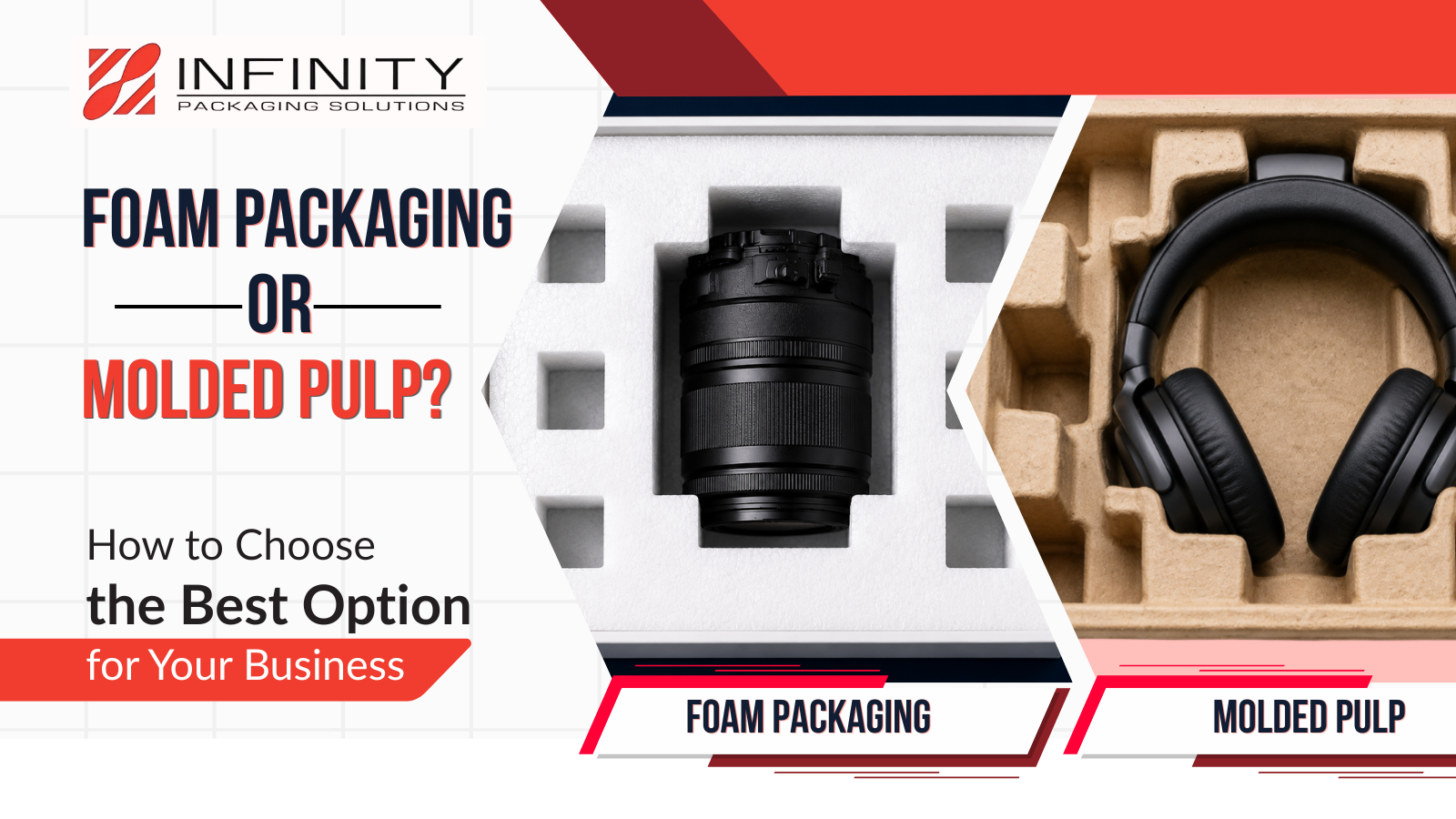
Choosing the Right Protective Packaging Starts with Understanding Your Product
Every product has a journey before it reaches the customer. Whether it’s a delicate electronic device, industrial equipment, medical instrument, or retail product, the packaging used during transportation plays a vital role in protecting it from damage while creating a positive customer experience.
Today, businesses are also expected to reduce packaging waste and support sustainability initiatives without compromising product safety. This has made the choice between foam packaging and molded pulp packaging more important than ever.
Although both materials are widely used in protective packaging, they serve different purposes. Foam packaging is known for its superior cushioning and precision fit, while molded pulp packaging has become a preferred choice for brands looking to reduce their environmental impact.
The right solution isn’t determined by trends or material costs alone. Instead, it depends on your product’s fragility, shipping conditions, customer expectations, sustainability goals, and long-term operational costs.
In this guide, we’ll compare foam packaging vs. molded pulp packaging, explore their strengths and limitations, and help you determine which option delivers the best value for your business.
Foam Packaging vs. Molded Pulp Packaging: Quick Comparison
If you’re looking for a quick answer, here’s how these two protective packaging materials compare.
| Feature | Foam Packaging | Molded Pulp Packaging |
| Product Protection | Excellent | Good to Excellent |
| Shock Absorption | Excellent | Good |
| Precision Fit | Excellent | Moderate |
| Sustainability | Moderate | Excellent |
| Recyclability | Material dependent | Highly Recyclable |
| Best For | Fragile & High-Value Products | Consumer & Retail Products |
| Brand Positioning | Premium Protection | Sustainable Packaging |
| Upfront Cost | Moderate to High | Low to Moderate |
Both packaging solutions perform well when matched with the right application. The key is selecting the material that best supports your product’s protection requirements and business objectives.
What Is Foam Packaging? Benefits, Uses, and Business Applications
Foam packaging is a protective packaging material specifically designed to absorb impact, reduce vibration, and secure products during storage and transportation. Unlike generic cushioning materials, custom foam inserts can be manufactured to match the exact shape and dimensions of a product, preventing unnecessary movement inside the package.
This level of precision makes foam packaging an ideal solution for products that are sensitive to shock or handling. From electronics and medical devices to industrial machinery and luxury products, businesses rely on foam inserts to reduce transit damage and maintain product quality.
Another advantage of foam packaging is its versatility. It can be engineered in different densities and designs to accommodate products of various shapes, sizes, and weights. Whether the objective is protecting delicate components or creating a premium unboxing experience, foam packaging offers a reliable solution for businesses that prioritize product safety.
Key Benefits of Foam Packaging
- Exceptional shock absorption and cushioning
- Precision-cut inserts for a secure product fit
- Reduces movement during transportation
- Helps minimize product damage and returns
- Suitable for reusable protective packaging
- Creates a premium presentation for high-value products
What Is Molded Pulp Packaging? Benefits, Sustainability & Best Uses
Molded pulp packaging is an environmentally friendly protective packaging solution made from recycled paper fibers and other renewable materials. It is molded into custom shapes that hold products securely while providing cushioning during shipping and handling.
As businesses place greater emphasis on sustainability, molded pulp packaging has become a popular alternative to plastic-based protective materials. It offers reliable product protection while supporting recycling initiatives and reducing dependence on non-renewable resources.
Modern manufacturing techniques have significantly improved the strength, appearance, and consistency of molded pulp packaging, making it suitable for a wide range of consumer goods, household products, food packaging, electronics accessories, and retail products.
For businesses looking to balance product protection with environmental responsibility, molded pulp packaging provides an effective and sustainable solution.
Key Benefits of Molded Pulp Packaging
- Manufactured using recycled and renewable materials
- Widely recyclable and often compostable
- Supports sustainable packaging initiatives
- Lightweight and cost-effective
- Suitable for high-volume production
- Strengthens eco-conscious brand positioning
Why Choosing the Right Packaging Matters
Protective packaging is often viewed as a shipping necessity, but its impact extends far beyond transportation. The packaging you choose influences product safety, operational efficiency, customer satisfaction, and overall business performance.
Damaged shipments don’t just result in replacement costs, they can lead to delayed deliveries, negative customer reviews, increased support requests, and lost business opportunities. Likewise, selecting packaging that exceeds your product’s protection requirements may increase costs without delivering additional value.
The most effective packaging strategy is one that balances protection, sustainability, efficiency, and cost. Instead of focusing only on material prices, businesses should evaluate how packaging performs throughout the entire supply chain, from manufacturing and warehousing to shipping, retail display, and the final customer experience.
When packaging aligns with both product requirements and business goals, it becomes more than a protective layer, it becomes a valuable part of your overall brand and logistics strategy.
Foam Packaging vs. Molded Pulp Packaging: Key Differences Every Business Should Know
Selecting the right protective packaging isn’t about choosing the most durable or the most sustainable material, it’s about choosing the one that best fits your product, supply chain, and business objectives.
While foam packaging and molded pulp packaging are both designed to protect products during storage and transportation, they differ significantly in terms of cushioning performance, environmental impact, customization, and long-term value. Understanding these differences helps businesses invest in packaging that minimizes damage, controls costs, and supports their brand image.
Let’s compare the two across the factors that matter most.
Product Protection: Which Packaging Offers Better Protection?
When product safety is the top priority, the level of protection offered by the packaging becomes the deciding factor.
Foam packaging is engineered to absorb impact, minimize vibration, and prevent products from shifting inside the box. Because foam inserts can be custom-cut to match the exact dimensions of a product, they provide excellent stability throughout the shipping process. This makes them especially suitable for fragile, high-value, or precision-engineered products that cannot tolerate movement or sudden impacts.
Molded pulp packaging also provides dependable protection, but its performance depends on the product’s weight, shape, and transportation conditions. It is well suited for products that require moderate cushioning and are not extremely sensitive to shock.
For businesses shipping delicate electronics, medical equipment, or precision components, foam packaging often provides greater peace of mind. For many retail and consumer products, molded pulp packaging offers more than enough protection while supporting sustainability goals.
Protection Comparison
| Protection Factor | Foam Packaging | Molded Pulp Packaging |
| Shock Absorption | Excellent | Good |
| Vibration Control | Excellent | Moderate |
| Product Stability | Excellent | Good |
| Custom Fit | Excellent | Moderate |
| Heavy Product Support | Excellent | Good |
| Everyday Consumer Products | Excellent | Excellent |
Best Choice: If product damage could result in expensive replacements or warranty claims, foam packaging is typically the safer investment.
Sustainability: Which Packaging Is More Environmentally Friendly?
Sustainability has become a key consideration in packaging decisions. Customers, retailers, and regulatory bodies increasingly expect businesses to reduce waste and use environmentally responsible materials.
Molded pulp packaging is manufactured from recycled paper fibers and renewable materials, making it one of the most sustainable protective packaging solutions available. It is widely recyclable and, in many cases, compostable, helping businesses reduce their environmental footprint.
Foam packaging, while highly effective for product protection, is generally less sustainable because many foam materials are petroleum-based. However, some modern foam materials can be recycled through specialized programs, and reusable foam packaging can also contribute to waste reduction when used in closed-loop supply chains.
The best sustainable packaging solution is one that protects the product effectively while minimizing unnecessary material waste. A damaged product often creates a larger environmental impact than using slightly more protective packaging.
Sustainability Comparison
| Sustainability Factor | Foam Packaging | Molded Pulp Packaging |
| Recyclability | Material Dependent | Excellent |
| Renewable Materials | Limited | Excellent |
| Compostable Options | Rare | Available |
| Plastic-Free Solution | No | Yes |
| Eco-Friendly Brand Image | Good | Excellent |
Best Choice: Businesses with strong sustainability goals or retailer packaging requirements will often benefit from molded pulp packaging.
Cost Comparison: Looking Beyond the Purchase Price
One of the biggest mistakes businesses make is comparing packaging based only on the cost per unit.
While molded pulp packaging often has a lower initial cost, the total value of packaging should be measured over its entire lifecycle. Factors such as product damage, replacement shipments, customer complaints, warranty claims, and logistics costs all contribute to the true cost of packaging.
Foam packaging generally requires a higher upfront investment, but it can significantly reduce product damage during transportation. For high-value products, avoiding just a few damaged shipments can quickly offset the additional packaging expense.
Molded pulp packaging, on the other hand, offers an economical solution for products that do not require maximum impact protection. It allows businesses to reduce packaging costs while supporting sustainability initiatives.
Cost Comparison
| Business Consideration | Foam Packaging | Molded Pulp Packaging |
| Initial Material Cost | Moderate to High | Low to Moderate |
| Risk of Product Damage | Very Low | Low |
| Replacement Costs | Lower | Moderate |
| Sustainability Value | Good | Excellent |
| Long-Term Business Value | High | High |
Key Takeaway: The lowest-cost packaging isn’t always the most cost-effective solution. The right packaging minimizes total business costs by balancing protection, efficiency, and sustainability.
Customer Experience: Packaging Is Part of Your Brand
The customer experience begins the moment a package arrives. Before a product is used, customers form an opinion based on how it is presented and protected.
Foam packaging creates a premium unboxing experience by holding products securely in place and presenting them in an organized, high-quality manner. This is especially important for luxury products, electronics, and premium equipment where presentation reinforces product value.
Molded pulp packaging appeals to environmentally conscious consumers who appreciate recyclable and plastic-free packaging. For many brands, sustainable packaging communicates responsibility, innovation, and environmental commitment.
Neither approach is universally better. The right choice depends on the message your brand wants to communicate.
If your goal is luxury and precision, foam packaging may be the better option.
If your brand focuses on sustainability and reducing environmental impact, molded pulp packaging can strengthen customer trust and brand loyalty.
Total Cost of Ownership: A Smarter Way to Evaluate Packaging
Successful businesses evaluate packaging as a long-term investment rather than a short-term expense.
Instead of asking, “Which material costs less?”, consider asking:
- How much will damaged shipments cost my business?
- How important is sustainability to my customers?
- Will better packaging reduce returns and warranty claims?
- Does my packaging reflect my brand values?
- Which option delivers the greatest value over time?
By considering the Total Cost of Ownership (TCO), businesses can make packaging decisions that support profitability, operational efficiency, and customer satisfaction—not just procurement budgets.
Which Packaging Performs Better During Shipping?
Shipping conditions vary significantly depending on product type, transportation method, and destination. A package shipped across the country or internationally may experience repeated handling, stacking, vibration, and accidental drops before reaching the customer.
Foam packaging performs exceptionally well in demanding shipping environments because it absorbs impact while keeping products securely positioned inside the box. This makes it a preferred choice for fragile products, international shipments, and complex logistics networks.
Molded pulp packaging performs reliably for many consumer and retail products, particularly when shipping conditions are less demanding and the products are designed to withstand moderate handling.
Rather than choosing the strongest packaging available, businesses should choose the level of protection appropriate for their shipping environment.
Key Takeaways
Both foam packaging and molded pulp packaging offer valuable benefits, but they solve different business challenges.
- Choose foam packaging when product protection, precision, and premium presentation are your highest priorities.
- Choose molded pulp packaging when sustainability, recyclability, and cost-effective protection are the primary goals.
- Evaluate packaging based on total business value rather than material cost alone.
- Consider your product’s fragility, shipping conditions, customer expectations, and brand positioning before making a final decision.
Best Industries for Foam Packaging and Molded Pulp Packaging
There isn’t a one-size-fits-all packaging solution. Every industry has unique transportation challenges, product characteristics, and customer expectations. A packaging material that works exceptionally well for one product may not provide the same value for another.
The key is understanding how your product moves through the supply chain and selecting packaging that delivers the right balance of protection, sustainability, efficiency, and cost.
Let’s explore where each packaging solution performs best.
Industries That Benefit Most from Foam Packaging
Foam packaging is the preferred choice for businesses where product protection is critical. Its excellent cushioning properties and ability to be custom-engineered make it ideal for products that are fragile, expensive, or highly sensitive to movement during transportation.
Electronics and Electrical Equipment
Electronic products often contain delicate internal components that can be damaged by even minor impacts. During shipping, packages are exposed to vibration, compression, and repeated handling, increasing the risk of product failure.
Custom foam inserts keep electronic devices securely positioned while absorbing shock throughout transit. This reduces the likelihood of cracked screens, damaged connectors, or internal component failures.
Foam packaging is widely used for products such as:
- Laptops and computers
- Networking equipment
- Consumer electronics
- Cameras
- Drones
- Testing instruments
- Electronic control systems
For electronics manufacturers, investing in better packaging often results in fewer warranty claims, reduced product returns, and improved customer satisfaction.
Medical Devices and Healthcare Equipment
Medical products require consistent protection because even minor transportation damage can affect product performance or calibration.
From diagnostic equipment to surgical instruments, these products often have strict quality requirements that make protective packaging an essential part of the supply chain.
Foam packaging helps protect:
- Medical devices
- Diagnostic instruments
- Laboratory equipment
- Healthcare electronics
- Precision sensors
For healthcare manufacturers, preventing damage isn’t just about reducing costs—it’s about ensuring product reliability and maintaining customer confidence.
Industrial Machinery and Engineering Components
Industrial products frequently travel long distances before reaching warehouses, distributors, or project sites. During transit, they may experience rough handling, heavy stacking, and repeated loading and unloading.
Foam packaging provides strong support for heavy or irregularly shaped components while minimizing movement inside the package.
It is commonly used for:
- Industrial equipment
- Machine parts
- Precision tools
- Automation components
- Manufacturing equipment
By reducing transit damage, businesses can avoid costly production delays and replacement shipments.
Luxury and Premium Products
For luxury brands, packaging is an extension of the product itself.
Customers purchasing premium goods expect an unboxing experience that reflects quality and attention to detail. Foam inserts create a clean, organized presentation while protecting valuable products from scratches and movement.
Luxury brands commonly use foam packaging for:
- Watches
- Fine jewelry
- Premium electronics
- Designer accessories
- Gift sets
A well-designed foam insert enhances both product protection and brand perception.
Industries That Benefit Most from Molded Pulp Packaging
Molded pulp packaging has become increasingly popular among businesses that want to combine product protection with environmental responsibility. Its recyclable composition and lightweight design make it an excellent choice for high-volume retail products and brands with sustainability goals.
Consumer Goods
Many everyday products do not require maximum-impact protection but still need reliable cushioning during transportation.
Molded pulp packaging provides sufficient protection while reducing plastic usage and supporting eco-friendly packaging initiatives.
Common applications include:
- Small household appliances
- Kitchenware
- Home décor
- Lifestyle products
- Storage accessories
Its clean appearance also appeals to brands looking for simple, sustainable packaging.
Cosmetics and Personal Care Products
Consumers increasingly expect beauty and personal care brands to use environmentally responsible packaging.
Molded pulp inserts help secure products inside the package while reinforcing a brand’s commitment to sustainability.
They are commonly used for:
- Skincare products
- Cosmetic gift boxes
- Hair care products
- Personal care accessories
- Wellness products
For brands targeting environmentally conscious consumers, sustainable packaging can become a competitive advantage.
Food and Beverage Packaging
The food and beverage industry has adopted molded pulp packaging for many protective applications because it is recyclable, lightweight, and suitable for large-scale production.
Typical applications include:
- Beverage carriers
- Bottle protection
- Egg cartons
- Fresh produce trays
- Food service packaging
Its ability to support sustainable packaging initiatives makes it an attractive solution for manufacturers and retailers alike.
Retail and E-commerce Products
Retail businesses must balance protection, presentation, shipping costs, and environmental responsibility.
Molded pulp packaging provides an effective solution for products that require moderate cushioning while helping businesses reduce plastic waste.
It is widely used for:
- Consumer electronics accessories
- Home improvement products
- Lighting products
- Office supplies
- Retail gift packaging
For businesses shipping thousands of products each month, sustainable packaging can strengthen customer perception while supporting corporate ESG goals.
Choosing the Right Packaging for Your Business
Rather than selecting packaging based on material preference alone, evaluate it against your business priorities.
The following decision matrix can simplify the process.
| If Your Priority Is… | Recommended Packaging |
| Maximum protection for fragile products | Foam Packaging |
| Sustainable and recyclable packaging | Molded Pulp Packaging |
| Premium product presentation | Foam Packaging |
| Reducing plastic usage | Molded Pulp Packaging |
| Protecting heavy industrial components | Foam Packaging |
| High-volume retail packaging | Molded Pulp Packaging |
| International shipping of delicate products | Foam Packaging |
| Supporting sustainability initiatives | Molded Pulp Packaging |
The goal isn’t to determine which material is universally better. It’s to identify which solution delivers the greatest value for your product, customers, and supply chain.
Common Packaging Mistakes Businesses Should Avoid
Selecting the wrong packaging can increase operational costs, damage customer relationships, and reduce profitability. Fortunately, many of the most common mistakes are avoidable with proper planning.
Choosing Packaging Based Only on Price
The lowest-priced packaging isn’t always the most economical. A small saving on packaging materials can quickly disappear if products arrive damaged and require replacements or refunds.
Instead of comparing unit costs, consider the total cost of protecting your product throughout its journey.
Ignoring Shipping Conditions
Products rarely travel directly from the factory to the customer. They may pass through multiple warehouses, distribution centers, and transportation networks before reaching their destination.
Packaging should be designed to withstand the conditions your products will actually experience—not the ideal conditions.
Using the Same Packaging for Every Product
Different products require different levels of protection.
A lightweight retail accessory doesn’t need the same packaging as a precision medical device or industrial component. Matching packaging to each product category improves both cost efficiency and product safety.
Overlooking Customer Expectations
Today’s customers notice packaging.
Some value premium presentation, while others actively look for recyclable and plastic-free packaging. Understanding your target audience helps you choose packaging that enhances the overall customer experience.
Skipping Packaging Testing
Even well-designed packaging should be tested before full-scale production.
Transit testing helps identify potential weaknesses and provides confidence that products will arrive in excellent condition under real-world shipping conditions.
How to Select the Best Packaging Solution
Choosing between foam packaging and molded pulp packaging becomes much easier when you evaluate your packaging requirements step by step.
Ask yourself the following questions:
- How fragile is the product?
- What shipping conditions will it experience?
- Is a custom-fit insert necessary?
- How important are sustainability goals to your business?
- What type of customer experience do you want to create?
- Will the packaging reflect your brand values?
- What are the long-term costs if products are damaged during transit?
Answering these questions provides a clearer picture of which packaging solution aligns with your operational needs and business objectives.
The best packaging decision is rarely based on a single factor. It comes from balancing protection, sustainability, customer expectations, logistics, and overall business value.
Why Partner with an Experienced Packaging Manufacturer?
Selecting the right packaging material is only part of the process. The design, engineering, material selection and manufacturing expertise behind the packaging are equally important.
An experienced packaging partner can help you:
- Evaluate your product’s protection requirements.
- Recommend the most suitable packaging material.
- Develop custom packaging solutions for your products.
- Optimize packaging for shipping efficiency.
- Reduce packaging waste without compromising protection.
- Improve packaging consistency across your product range.
- Support sustainability initiatives through smarter material selection.
Working with packaging specialists early in the product development process helps businesses avoid costly redesigns, improve packaging performance, and create solutions that deliver long-term value.
Ready to Find the Right Packaging Solution?
Every product has unique protection requirements, and every business has different priorities. Whether your focus is reducing shipping damage, improving sustainability, enhancing the customer experience, or optimizing packaging costs, choosing the right solution can make a measurable difference across your entire operation.
At Infinity Pak, we work with manufacturers, retailers, and businesses across multiple industries to develop custom protective packaging solutions that balance product protection, operational efficiency, and sustainability. From custom foam packaging to molded pulp solutions, our team helps you identify the best packaging strategy for your products and supply chain.
If you’re planning a new product launch, redesigning existing packaging, or looking for ways to improve shipping performance, our packaging specialists are ready to help you create a solution that protects your products while supporting your long-term business goals.
Key Takeaways
| Business Objective | Recommended Approach |
| Protect fragile and high-value products | Choose custom foam packaging with engineered inserts. |
| Improve sustainability | Consider molded pulp packaging made from recyclable materials. |
| Reduce shipping damage | Match packaging design to real transportation conditions. |
| Enhance customer experience | Use packaging that reflects your product quality and brand values. |
| Improve operational efficiency | Evaluate packaging based on long-term performance, not just initial cost. |
| Lower total business costs | Consider protection, logistics, returns, and customer satisfaction together. |
The best packaging solution is the one that protects your products, supports your customers, and contributes to the long-term success of your business. By selecting the right material for the right application, you can build a packaging strategy that delivers value far beyond the shipping box.
Final Thoughts
Choosing between foam packaging and molded pulp packaging isn’t about finding a universally better material—it’s about identifying the solution that delivers the greatest value for your specific products and business goals.
If your products require exceptional protection against impact, vibration, or movement during shipping, custom foam packaging offers outstanding performance and helps reduce costly product damage. Its ability to provide precision-engineered protection makes it an excellent investment for electronics, medical devices, industrial equipment, and other high-value products.
If sustainability is a priority, molded pulp packaging provides an environmentally responsible alternative that supports recycling initiatives while offering dependable protection for many consumer and retail products. It enables businesses to reduce plastic usage, strengthen their sustainability efforts, and meet the growing expectations of environmentally conscious customers.
Rather than focusing solely on material costs, successful businesses evaluate packaging based on the value it creates throughout the supply chain. The right packaging solution protects products, improves operational efficiency, reduces returns, enhances customer satisfaction, and reinforces brand credibility.
As customer expectations continue to evolve and supply chains become more complex, investing in the right protective packaging is no longer just a logistics decision, it’s a strategic business decision that can influence profitability, operational performance and long-term growth.
Frequently Asked Questions About Foam Packaging and Molded Pulp Packaging
Q. Which packaging material offers better protection?
Both materials provide reliable protection, but their performance depends on the product being shipped. Foam packaging is designed to deliver superior shock absorption, vibration control, and a precision fit, making it the preferred choice for fragile, high-value, or sensitive products. Molded pulp packaging provides dependable cushioning for many retail and consumer products while offering the added advantage of sustainability.
Q. Is molded pulp packaging strong enough for shipping?
Yes. Modern molded pulp packaging is engineered to protect a wide variety of products during transportation. It performs particularly well for consumer goods, household products, cosmetics, food packaging, and retail items. However, products that are extremely fragile or require precise positioning may benefit from custom foam packaging.
Q. Is foam packaging recyclable?
Many foam materials can be recycled through specialized recycling programs, although recycling options vary depending on the material and local facilities. Businesses looking to improve sustainability should work with packaging manufacturers to identify recyclable or reusable foam solutions that align with their environmental goals.
Q. Which packaging material is more sustainable?
Molded pulp packaging is generally considered the more sustainable option because it is manufactured from recycled paper fibers and renewable materials. It is widely recyclable and often compostable, making it an excellent choice for businesses looking to reduce plastic usage and improve their environmental performance.
Q. Which packaging is better for electronics?
Electronics often contain delicate components that can be damaged by vibration or impact during transportation. Custom foam packaging provides a secure fit and excellent cushioning, making it one of the most effective solutions for protecting laptops, networking equipment, medical electronics, testing instruments, and other precision devices.
Q. Can businesses use both foam packaging and molded pulp packaging?
Absolutely, Many manufacturers use different packaging materials for different product lines. Products requiring maximum protection may use custom foam inserts, while consumer products with lower protection requirements can benefit from molded pulp packaging. Using the right material for each application often delivers the best balance between protection, sustainability, and cost.
Q. How should businesses compare packaging costs?
Instead of comparing packaging based only on the purchase price, businesses should evaluate the overall value it delivers.
Consider factors such as:
- Product damage and replacement costs
- Customer returns
- Warranty claims
- Shipping efficiency
- Storage requirements
- Sustainability objectives
- Customer satisfaction
Looking at the complete lifecycle of the packaging helps identify the solution that offers the greatest long-term return on investment.
Q. What factors should be considered before choosing protective packaging?
Before selecting a packaging solution, ask the following questions:
- How fragile is the product?
- Will it be shipped locally or internationally?
- Does it require a custom-fit insert?
- Are sustainability goals important to your business?
- What level of protection is necessary?
- How do you want customers to perceive your brand?
- What are the financial consequences of damaged shipments?
Answering these questions makes it easier to select packaging that supports both operational performance and customer expectations.