




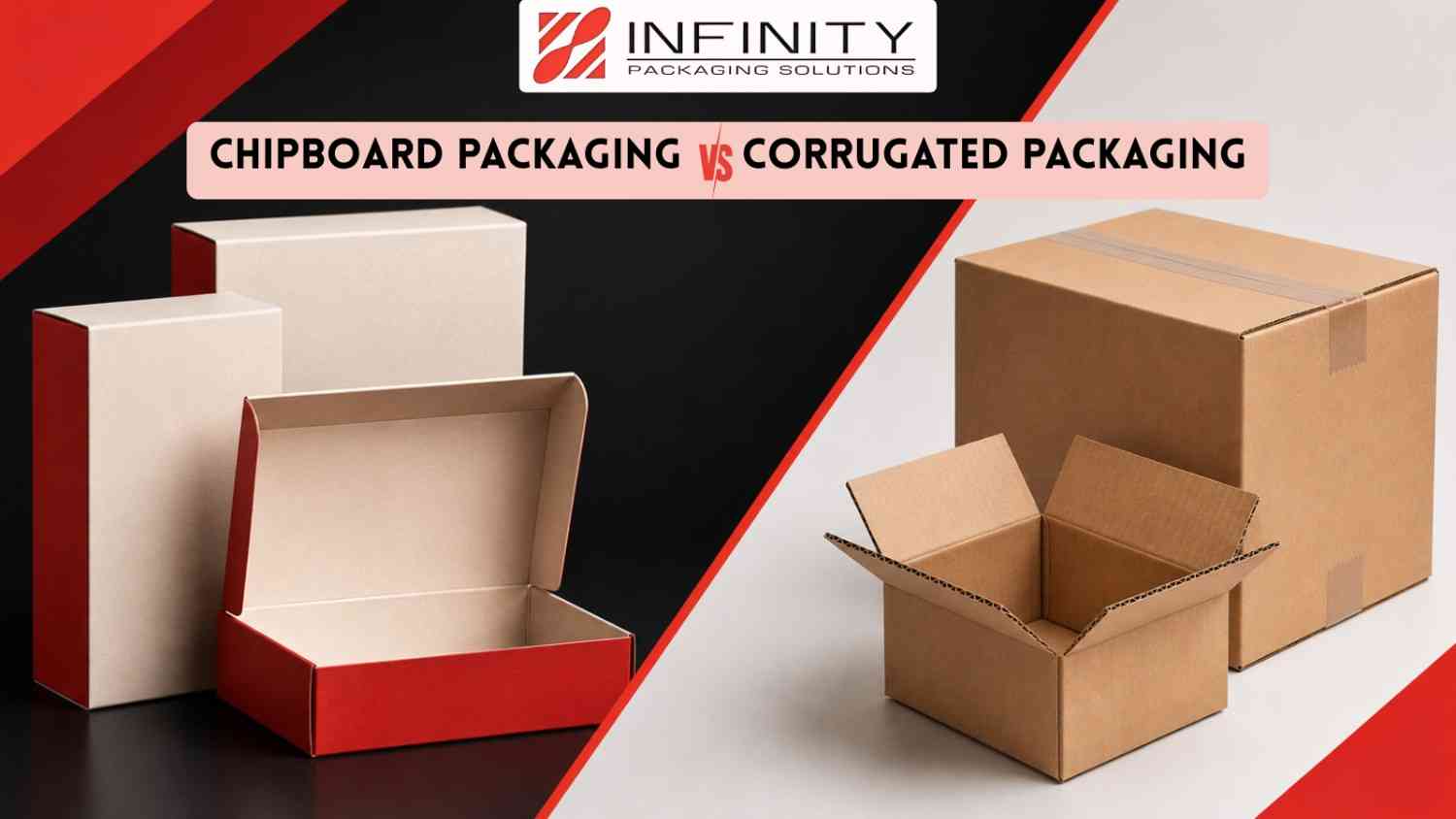
Choosing between chipboard packaging and corrugated packaging is an important decision for any business that sells, stores, or ships physical products. The right packaging affects product protection, branding, customer experience, shipping costs, sustainability, and even repeat purchases.
Chipboard boxes and corrugated boxes may look similar at first glance, but they serve different purposes. Chipboard packaging is commonly used for lightweight retail products, premium presentation, and printed branding. Corrugated packaging is built for strength, shipping performance, and better protection during transportation.
In many cases, the best packaging decision is not choosing one over the other. Many brands use both materials together: chipboard packaging for retail presentation and corrugated packaging for outer shipping protection. This guide explains the difference between chipboard and corrugated packaging, when to use each option, and how businesses can make a smarter packaging decision.
Which Is Better for Your Business: Chipboard Packaging or Corrugated Packaging?
- Choose chipboard packaging when your priority is retail presentation, lightweight product packaging, print quality, and brand appeal.
- Choose corrugated packaging when your priority is shipping strength, product protection, durability, and logistics efficiency.
For premium products sold online, using both together often provides the best balance between presentation and protection.
What Is Chipboard Packaging?
Chipboard packaging is made from paperboard, often using recycled fibers. It is usually thinner and lighter than corrugated packaging, which makes it a strong option for retail products, lightweight goods, and branded presentation boxes.
Chipboard boxes are commonly used for cosmetics, skincare products, food items, supplements, pharmaceuticals, stationery, small consumer goods, and retail display packaging. Because chipboard has a smooth surface, it works well for high-quality printing, custom designs, brand colors, product information, and premium finishes.
Businesses often choose custom chipboard boxes when they want packaging that looks polished on shelves, supports brand recognition, and creates a better unboxing experience.
What Is Corrugated Packaging?
Corrugated packaging is made with a fluted paper layer placed between linerboard layers. This structure gives corrugated boxes more strength, cushioning, and resistance during handling, stacking, and shipping.
Corrugated boxes are widely used for e-commerce orders, subscription boxes, fragile products, electronics, glass items, bulk shipments, warehouse storage, and long-distance shipping. Their structure helps absorb shock and reduce product damage during transit.
Businesses often choose custom corrugated boxes when product safety, shipping performance, and logistics efficiency are more important than lightweight retail presentation alone.
The Main Difference Between Chipboard and Corrugated Packaging
The main difference between chipboard and corrugated packaging is strength and purpose. Chipboard packaging is thinner, smoother, and better suited for retail presentation. Corrugated packaging is thicker, stronger, and better suited for shipping and product protection.
Chipboard is mainly used as primary packaging for lightweight products. Corrugated packaging is commonly used as secondary or shipping packaging, especially when products need extra protection during transportation.
Chipboard vs Corrugated Packaging Comparison Table
| Factor | Chipboard Packaging | Corrugated Packaging |
| Best Use | Retail packaging, product display, lightweight goods, premium branding | Shipping boxes, e-commerce packaging, fragile products, bulk orders |
| Strength | Moderate strength for lightweight products | High strength for shipping and handling |
| Print Quality | Excellent surface for detailed branding and printed designs | Good print options, especially for branded mailer boxes and shipping cartons |
| Weight | Lightweight and material-efficient | Heavier depending on flute type, board grade, and box size |
| Protection Level | Suitable for low-risk handling and shelf display | Better cushioning and protection during transit |
| Cost Consideration | Often cost-effective for lightweight retail packaging | May cost more, but can reduce damage-related losses |
| Sustainability | Often recyclable and may contain recycled fiber | Recyclable and often made with recycled content |
| Best Industries | Cosmetics, food, supplements, stationery, retail goods | E-commerce, electronics, glassware, subscription boxes, industrial products |
When Should You Choose Chipboard Packaging?
Chipboard packaging is a strong choice when visual presentation and branding are key priorities. If your product is lightweight and mainly displayed on a retail shelf, chipboard boxes can help create a polished and professional look without unnecessary bulk.
- Choose chipboard packaging if your business needs:
- Retail packaging boxes with strong visual appeal
- Custom printed boxes for cosmetics, skincare, food, or supplements
- Lightweight packaging for small consumer products
- Cost-effective packaging for shelf-ready presentation
- Smooth surfaces for logos, product details, colors, and premium finishes
For example, a skincare brand may use a printed chipboard box to give its product a premium retail presence. A supplement company may choose chipboard packaging to keep the box lightweight while still communicating product information clearly.
When Should You Choose Corrugated Packaging?
Corrugated packaging is the better choice when products need stronger protection during storage, shipping, or delivery. Its layered structure helps protect products from pressure, movement, and impact during transportation.
Choose corrugated packaging if your business needs:
- Shipping boxes for e-commerce orders
- Protective packaging for fragile or heavy products
- Packaging for bulk shipments and warehouse handling
- Durable boxes for subscription products
- Outer cartons for products already packed in retail boxes
For example, an online brand selling glass jars, electronics, or premium gift sets may need corrugated boxes to reduce the risk of shipping damage and improve customer satisfaction.
Can You Use Chipboard and Corrugated Packaging Together?
Yes. Many successful brands use chipboard and corrugated packaging together as part of a layered packaging strategy. This approach is especially useful for premium products that need both strong branding and reliable shipping protection.
For example, a skincare product may be placed inside a beautifully printed chipboard box for retail presentation. That chipboard box can then be shipped inside a corrugated box to protect the product during transit. The customer receives an attractive unboxing experience, while the business reduces the risk of damage during delivery.
This layered packaging approach is common in cosmetics, supplements, food products, electronics, luxury retail, subscription boxes, and e-commerce packaging. It combines the visual appeal of chipboard packaging with the shipping strength of corrugated packaging.
Industry-Wise Packaging Recommendations
| Industry / Product Type | Recommended Packaging Approach |
| Cosmetics and Skincare | Use chipboard boxes for premium product presentation and corrugated boxes for e-commerce shipping. |
| Food and Beverage Products | Use chipboard for lightweight retail items and corrugated boxes for multi-unit shipping or bulk orders. |
| Supplements and Health Products | Use chipboard for shelf-ready product boxes and corrugated cartons for shipping and distribution. |
| Electronics | Use corrugated packaging with inserts or protective layers due to fragility and higher product value. |
| Subscription Boxes | Use corrugated mailer boxes for shipping strength, with custom print for brand experience. |
| Retail Consumer Goods | Use chipboard boxes when shelf appeal and printed branding are the main goals. |
| Glassware and Fragile Items | Use corrugated packaging with proper cushioning to reduce breakage during transit. |
Sustainability Comparison
Sustainability has become a major consideration for businesses and consumers. Both chipboard packaging and corrugated packaging can support environmental goals when they are designed responsibly, sourced properly, and recycled after use.
Chipboard packaging is often produced using recycled fibers and generally uses less material than heavier packaging formats. This can make it a good choice for lightweight retail products where heavy-duty protection is not required.
Corrugated packaging is also widely recyclable and frequently contains recycled content. Because it provides stronger protection during shipping, it can also help reduce waste caused by damaged products, returns, and replacement shipments.
When comparing sustainability, businesses should not look at only one factor. The better approach is to evaluate recyclability, recycled content, product protection, transportation efficiency, box size optimization, material usage, and lifecycle performance.
Cost, Shipping, and Product Protection Considerations
Packaging cost should not be measured only by the price of the box. Businesses should also consider product damage, return rates, storage needs, shipping weight, brand value, and customer experience.
Chipboard packaging may be more cost-effective for lightweight retail products because it uses less material and offers a strong branding surface. However, if a chipboard box is used for a product that requires more protection, the business may face higher costs from damaged products or poor customer experience.
Corrugated packaging may cost more depending on size, board grade, flute type, and customization. However, it can help protect products during shipping and reduce losses caused by transit damage.
The best packaging choice is the one that protects the product, supports the brand and fits the business model. For many growing brands, the most effective solution is a custom packaging strategy that balances presentation, protection, and cost control.
How to Choose the Right Packaging for Your Product
Before choosing between chipboard boxes and corrugated boxes, businesses should evaluate the complete product journey. Important questions include:
- Is the product lightweight, heavy, fragile or high-value?
- Will the product be displayed on a retail shelf or shipped directly to customers?
- Does the packaging need premium printing or a luxury unboxing experience?
- How far will the product travel before reaching the customer?
- Will the product be shipped individually, in bulk or through a distribution network?
- Does the product need extra inserts, cushioning or outer protection?
- What are the brand’s sustainability and cost goals?
Answering these questions helps businesses avoid under-packaging, over-packaging, and unnecessary costs. It also helps create a better balance between customer experience and shipping performance.
How InfinityPak Helps Businesses Choose Better Packaging
InfinityPak serves businesses across the United States as a packaging manufacturer, supplier and wholesale partner. Rather than recommending a one-size-fits-all solution, InfinityPak helps businesses evaluate packaging based on product dimensions, weight, fragility, shipping requirements, branding goals, and industry standards.
Businesses seeking premium retail presentation often benefit from custom chipboard boxes. Companies focused on shipping performance and logistics efficiency often choose corrugated boxes. In many cases, the best solution combines both materials as part of a layered packaging system.
InfinityPak can support businesses with custom box sizing, material selection, print and branding options, wholesale packaging supply, retail packaging solutions, shipping packaging solutions, and packaging guidance for e-commerce and product-based brands.
By understanding the complete product journey, InfinityPak helps brands improve product protection, reduce packaging-related costs, strengthen branding, and create a better customer experience.
Final Verdict: Chipboard Packaging vs Corrugated Packaging
There is no universal winner in the chipboard packaging vs corrugated packaging debate because each material serves a different purpose. Chipboard packaging excels in branding, visual appeal, lightweight retail presentation, and high-quality printing. Corrugated packaging excels in shipping performance, product protection, durability, and logistics efficiency.
Businesses should choose packaging based on product type, industry requirements, customer expectations, shipping conditions, branding goals, and supply chain needs. In many cases, using both chipboard and corrugated packaging together provides the ideal balance between presentation and protection.
For brands looking to scale, improve customer experience, and reduce packaging-related risks, selecting the right packaging material is a strategic business decision, not just a purchasing decision.
Looking for the right packaging solution for your product? InfinityPak helps businesses across the United States choose between custom chipboard boxes, corrugated boxes, and layered packaging solutions based on product size, weight, branding needs, and shipping requirements. Contact InfinityPak today to get expert guidance and custom packaging support for your business.
Frequently Asked Questions
Q. What is the main difference between chipboard and corrugated packaging?
The main difference is structure and purpose. Chipboard packaging is thinner and better for lightweight retail products and branding. Corrugated packaging has a fluted structure that provides more strength and protection for shipping.
Q. Is chipboard packaging good for shipping?
Chipboard packaging can work for lightweight products and low-risk handling, but it is usually not the best choice for fragile, heavy, or long-distance shipping. For stronger protection, corrugated packaging is generally recommended.
Q. Which is better for retail packaging: chipboard or corrugated?
Chipboard packaging is usually better for retail packaging because it provides a smooth surface for printing, branding, product information, and shelf presentation.
Q. Which is better for e-commerce packaging?
Corrugated packaging is usually better for e-commerce because it offers stronger protection during shipping and handling. Many online brands use corrugated mailer boxes or shipping boxes to reduce damage.
Q. Can chipboard and corrugated packaging be used together?
Yes. Many brands use chipboard boxes for product presentation and corrugated boxes for outer shipping protection. This approach is useful for premium retail products sold online.
Q. Are chipboard and corrugated boxes recyclable?
Both chipboard and corrugated boxes can be recyclable when designed and disposed of properly. Businesses should also consider recycled content, material usage, shipping efficiency, and product protection when evaluating sustainability.
Q. Which packaging option is more cost-effective?
Chipboard packaging may be more cost-effective for lightweight retail products. Corrugated packaging may cost more depending on strength and size, but it can reduce product damage and shipping-related losses.
Q. How can InfinityPak help choose the right packaging?
InfinityPak helps businesses evaluate product size, weight, fragility, branding goals, shipping requirements and industry needs to recommend the right chipboard, corrugated, or layered packaging solution.